Most Popular Call A Computer Time Shared Mainframe Computer System Games

MegaWars III
1984
MegaWars III
1984
MegaWars III was a massively multiplayer empire building game written by Kesmai and run continuously on CompuServe between 1984 and 1999. It was one of CompuServe's most popular games throughout its lifetime with thousands of players joining the month-long game cycles. It was only shut down after CIS was purchased by AOL and moved to the web-based "CompuServe 2000" interface that would not cleanly support it. A modified version, Stellar Emperor ran for much of the same time period on GEnie, also ending in 1999 when that service was shut down by General Electric. A new version of Stellar Emperor, sporting a new client-server GUI, was run for a short period on Kesmai's GameStorm.Marienbad
1962
Marienbad
1962
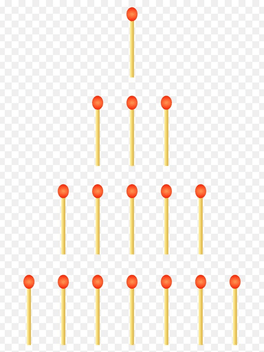
Marienbad is an adaptation of the strategy game Nim, originally written in Poland for the Odra 1003 mainframe. The game did not originally have a specific title; in later literature the name Marienbad was applied retroactively. It is one of the earliest Polish computer games. It was inspired by a variant of Nim seen in the 1961 movie Last Year at Marienbad and described under the name "Marienbad" in the magazine Przekrój. There are several rows (four by default) of matchsticks, with a different number of matchsticks in each row. Both players (the human and the computer) take turns, in each move taking away at least one matchstick from a single row. The player left with the final matchstick loses.Hutspiel
1955
Hutspiel
1955
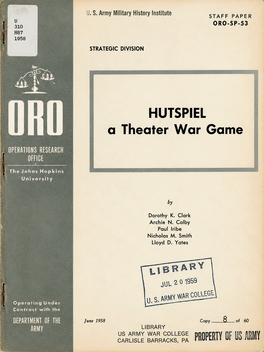
Hutspiel is a military training simulation for the Goodyear Electronic Differential Analyzer (GEDA) that simulates at a theatre level. Its intention was to study the use of tactical nuclear weapons and conventional air support in Western Europe in the event of a Soviet invasion. The game pits two players against each other with one controlling NATO forces in France, Belgium and West Germany, and the other in control of a Soviet invasion force trying to penetrate a 150 mile frontage. Players could allocate forces across sectors of the map and set targets (such as airfields, enemy troops, supply depots and transportation facilities) for planes and nukes. Early versions of the game would have the computer continue the simulation until it was paused for further input. In later versions the game used turns of fixed time increments. The game modeled troop reinforcement, resupply and movement by rail. It did not account for terrain or weather.Core War
1984
Core War
1984
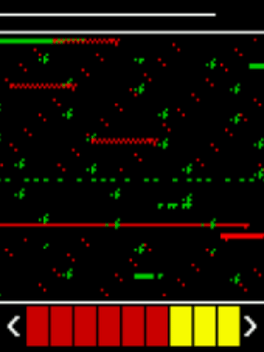
Core War is a 1984 programming game created by D. G. Jones and A. K. Dewdney in which two or more battle programs (called "warriors") compete for control of a virtual computer. These battle programs are written in an abstract assembly language called Redcode.MegaWars
1983
MegaWars
1983
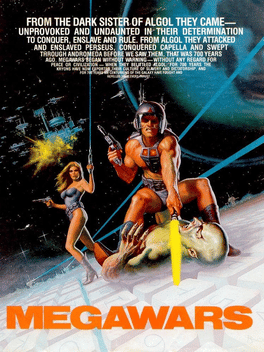
MegaWars was an online multiplayer space empire building game hosted on CompuServe starting in 1983. The original MegaWars was a port of Decwar with all references to Star Trek removed.