Sonic the Hedgehog 3 is an LCD game created by Tiger Electronics in 1994. It was available in the Tiger's second generation casing and also as a Pocket Arcade version.
The game features a standard direction pad and 3 buttons, "Tails", "pick", and "spin". Both consoles also contain four function buttons to turn off the system, toggle sound effects, pause the game, and turn on the console and start the game. The standard version requires two AA batteries to operate. The background of the game is a rendering of the Blue Sphere, with the floor of Hydrocity Zone. When the game starts, the Sonic the Hedgehog 3 title screen theme is heard. The level theme is the Angel Island Zone theme.
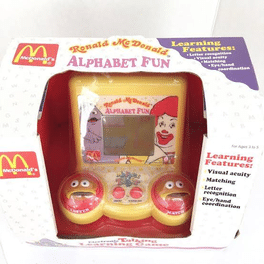
Sonic the Hedgehog Extreme Boarding is an LCD game created for distribution at McDonald's restaurants.. They were offered as a part of Happy Meals for a limited time in 2004. This particular game was also released under the name Sonic Skateboard.
There are two main buttons on the game which control left and right movement. The game is a recreation of the Sonic 2 special stage as the player moves forward avoiding obstacles. There are three lanes that can be moved to and one is always open, while others may be occupied by bombs. There are also Rings which litter the screen, which can be collected. Once the player has collected 20 rings, they will move to the next level, which will be more fast paced, and thus harder. There are four levels to complete, and when one is completed, you will see a “Thumbs Up”, as it appeared in Sonic The Hedgehog 2.
In 1997, a Bomberman-themed LCD game was released by Bandai. The game is played much like the original Bomberman games, with the player having to destroy blocks in a grid-like maze in order to find the entrance to the next level. The game also features sound effects and music.
Pokémon Pikachu, also known as Pocket Pikachu in Japan, is a limited series of two portable Pokémon digital pets (similar to Tamagotchi) featuring the famous yellow electric-type Pokémon, Pikachu. Released on March 27, 1998, in Japan (November 2, 1998, in North America).
The Tamagotchi is a handheld digital pet that was created in Japan by Akihiro Yokoi of WiZ and Aki Maita of Bandai. It was released by Bandai on November 23, 1996 in Japan and on May 1, 1997 in the rest of the world, quickly becoming one of the biggest toy fads of the late 1990s and the early 2000s. This version is also officially known as "Gen1" to differentiate it from the later release of "New Species Discovered!! Tamagotchi" also known as "Gen 2".
The Digital Monster is a digital pet created by WiZ and Bandai that spawned the Digimon franchise. It was released by Bandai on June 26, 1997 in Japan and on December 5, 1997 in North America. This pet was a masculine counterpart to the Tamagotchi, which was deemed more appropriate for girls. It was similar to earlier virtual pets with the distinctions of being a fighting pet that could connect with others like it.
Ganbare Goemon: Ebisumaru Kiki Ippatsu is a portable electronic handheld game in the Ganbare Goemon series developed and published by Konami in 1990 in Japan.
In this LCD game, Goemon has to rescue Ebisumaru who has been captured by evildoers.
Dr. Mario is one of the two LCD game watches belonging to the Gamewatch Boy line released in 1992 by Mani Industries. It plays similarly to the original game.
Mario's Egg Catch Game is one of the three LCD game watches belonging to the Super Mario Bros. Watch line released in 1990 as promotional items by McDonald's in the US and Japan.
Luigi's Hammer Toss Game is a Game Watch released by Nintendo in 1990. The game has you play as Mario's brother Luigi where you earn points by moving Luigi left and right to deflect the Hammers thrown by two cloud-riding Hammer Bros. with his shield. Since Mario is Missing! was released in 1992, Luigi's Hammer Toss Game is technically Luigi's first solo game.
Princess Toadstool's Castle Run Game is one of the three LCD game watches belonging to the Super Mario Bros. Watch line released in 1990 as promotional items by McDonald's in the US and Japan. It is the first game to feature Princess Toadstool as the sole playable character. The gameplay is identical to that of many LCD racing games such as Super Mario Race.
The Star Fox Game Watch is a game in the appearance of a wristwatch that was developed by Nintendo and Nelsonic. It's a LCD game that could be achieved by buying two boxes of Kellogg's Corn Flakes and then sending the form back to Kellogg's for a free copy. The purpose of the game is to defeat the Attack Carrier while dodging several obstacles and while being airborne. There is a total of four levels in the game. When buying the game, a pair of earphones which are made for the game is included.
Super Mario Bros. 3, also known as Super Mario 3 (on the bezel) and Super Mario III (in the instruction leaflet) is a watch containing a simplified game based off of Super Mario Bros. 3. It is the second of four Nelsonic Game Watch games based on the Mario franchise. The game watch was released by Nelsonic and licensed by Nintendo in 1990. In Europe, the game watch was rereleased by Zeon in 1992, alongside The Legend of Zelda and Tetris.
Super Mario Bros. is an LCD game watch based off of the NES original. It was released in 1989 as the first of four Mario Nelsonic Game Watches. The game received a direct sequel in the Super Mario Bros. 3 game watch.
The Legend of Zelda Game Watch, referred to as The Legend of Zelda 8321 in the instruction manual, is a combined game and wristwatch released by Nelsonic Industries.