New Famicom Games - Page 31

Tao
1989
Tao
1989
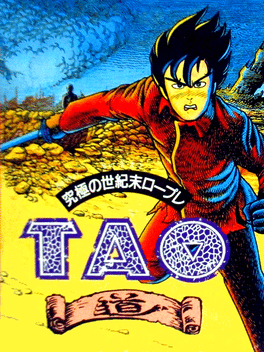
Tao is a quirky role-playing game with heavy religious themes. The game concerns a spiritual wanderer who is attempting to avert the end of days predicted by Nostradamus in a near future which has already been wracked with disaster. In order to do this, he must invoke the powers of various religions and belief systems, including those from Hinduism, Buddhism, Christianity and other faiths. The game is known for its abstract and unusual personality.Mirai Senshi: Lios
1989
Mirai Senshi: Lios
1989
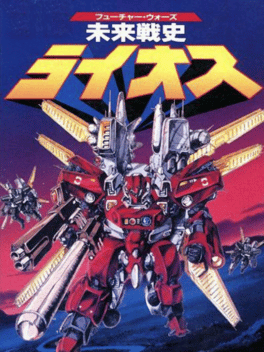
Future Wars: Lios is a turn-based strategy game developed and published by Pack-In-Video, the same developers who brought us Die Hard (NES). In this game, you play as Cecilia and her army of robots. You must make it to Goinkia's castle and stop him from taking over. To do this, you must travel the overworld and select a location. Once you do, you must take out the enemy's commander robot and then the enemy's base. Then you will win and will be allowed to progress. Sometimes defeating enemies unlocks new weapons.Softball Tengoku
1989
Softball Tengoku
1989
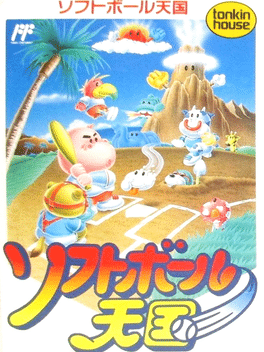
With 60 characters with different abilities and appearance, this is softball unlike you ever experienced before. Batter, pitch, catch, get the team you create to the big leagues. With different stages and unique abilities, no match is ever the same!Golf-ko Open
1989
Cosmic Epsilon
1989
Cosmic Epsilon
1989
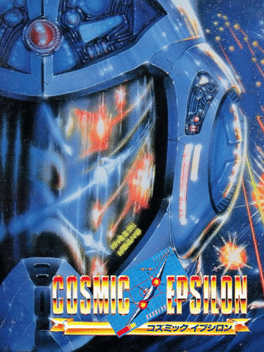
An alien menace from the Epsilon Empire threatens to destroy life on Earth as you know it! Take flight and blast your enemies down in this rail shooter that is reminiscent of Space Harrier. Cosmic Epsilon puts the NES through its paces with a stereoscopic 3D mode and advanced background scaling.Terao no Dosukoi Oozumou
1989
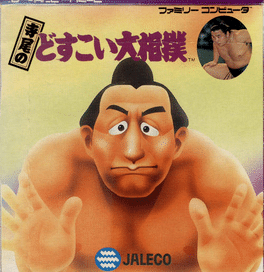
Terao no Dosukoi Oozumou is a Sports game, developed by TOSE and published by Jaleco Entertainment, which was released in Japan in 1989.Ninja Cop Saizou
1989
Gozonji: Yaji Kita Chin Douchuu
1989
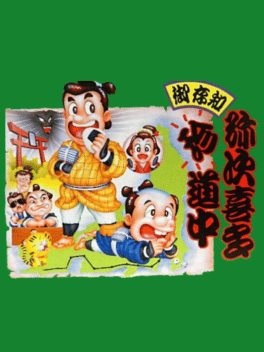
Gozonji: Yaji Kita Chin Douchuu is an Adventure game, developed by Hyperware and published by HAL Labs, which was released in Japan in 1989.Venus Senki
1989
Venus Senki
1989
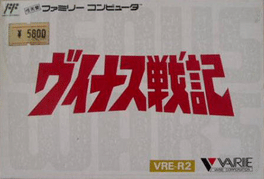
Venus Senki is a Strategy game, developed by Human Entertainment and published by Varie, which was released in Japan in 1989.Mahjong Taikai
1989
Mahjong Taikai
1989
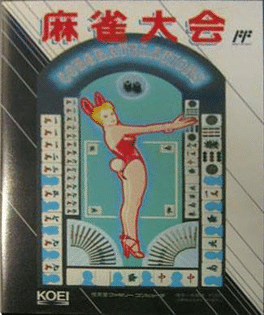
The first installment in Koei's mahjong series. Mahjong Taikai ("Mahjong Tournament") is a 1989 Famicom mahjong game from Koei and an unknown developer. It features multiple historical figures as possible CPU opponents, including Masamune Date and Napoleon Bonapart. As with any mahjong game, the goal is to complete a winning hand before any of the other players can, and the player earns an amount of points dependent on the "strength" of their winning hand. They might also lose points depending on who won and how. Koei would continue making Mahjong Taikai games for other platforms, including Super Mahjong Taikai for the Super Famicom in 1992.Ochin ni Toshi Puzzle Tonjan!?
1989
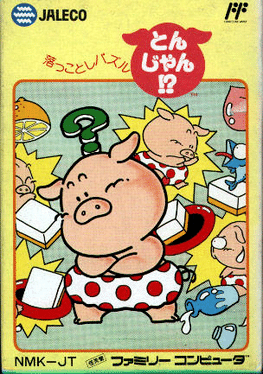
A block moving puzzle game similar to Sokoban. Okkotoshi Puzzle Tonjan!? ("Drop Down Puzzle Tonjan?!", sometimes known as simply Tonjan) is a puzzle game from NMK that features anthropomorphic pigs pushing mahjong tiles around in a maze, attempting to push entire stacks down one of the many holes in the area. Bonus points are awarded for pushing certain specified tiles into holes first, and there's one tile in particular that will complete the level once pushed down a hole and is the only compulsory target. Future levels increase the number of tiles and the difficulty, adding fish tiles that cause the player to lose a life if they are pushed down a hole. Okkotoshi Puzzle Tonjan!? appears to a sequel to NMK's earlier Arcade multiplayer action game Butasan, which features similar looking pigs. The rights to the Arcade version of Tonjan were sold to a Korean company, Dooyong, which turned it into a game named Yam! Yam?! featuring a tanooki wearing an apron.Major League
1989
Major League
1989
This standard baseball game from Irem has the movie license for Major League, but doesn't actually use it much in-game.Dragon Ball 3: Goku-den
1989
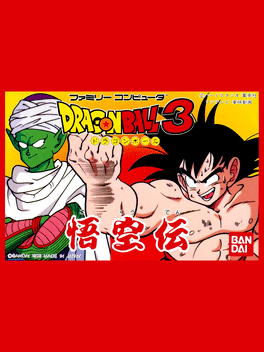
Dragon Ball 3: Goku-den is a role playing video game released only in Japan by Bandai. It is the third Dragon Ball video game for Famicom (its predecessors being Dragon Ball: Shenron no Nazo and Dragon Ball: Daimaou Fukkatsu). Its sequel is Dragon Ball Z: Kyoushuu! Saiyan. You control Son Goku and his friends Krillin and Yamcha in this game. The gameplay is mostly based on training your characters and then taking them to fight enemies, advancing the plot. All the activities in the game (including walking around on the world map) are performed through choosing one of the available cards. Depending on the value of the card, you can move a certain amount of squares on the map, have an advantage in a battle, etc.Chuka Taisen
1989
Chuka Taisen
1989
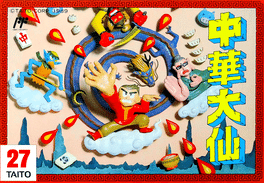
The player controls Mike Chen floating on a cloud, maneuvering around the screen and shooting balls of energy at flying enemies. Powerups can be collected for stronger and faster firepower. Some parts of the game stage have doors that give the player the opportunity to buy special bomb types with collectible credits. Each stage has its own mini-boss and big boss. Throughout the stages, the player restarts at certain checkpoints after losing a life.Hokuto no Ken 3: Shinseiki Souzou Seiken Retsuden
1989
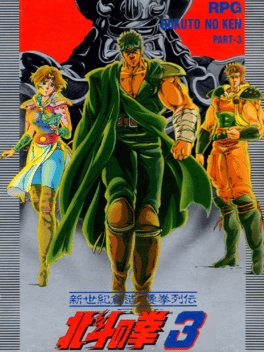
Hokuto no Ken 3: Shinseiki Souzou Seiken Retsuden is the third Hokuto no Ken video game developed by Shouei Systems and released by Toei Animation for the Family Computer (the Japanese version of the Nintendo Entertainment System) on October 19, 1989. Unlike the first two Hokuto no Ken video games for the platform, which were side-scrolling action games, Hokuto no Ken 3 is a role playing game which adapts the storyline of the original manga from the beginning to the Kingdom of Shura story arc. It was the first in a trilogy of RPGs based on the franchise.Koushien
1989
Koushien
1989
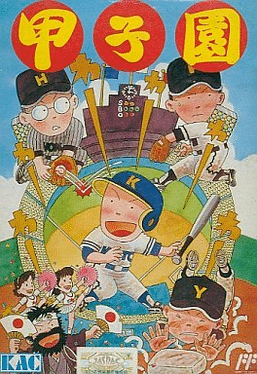
A Famicom baseball game based on Japanese highschool baseball. It saw multiple sequels for the Super Famicom. Koushien is the first game in K Amusement's Koushien series of baseball games that focuses on the highschool level of competition. Koushien refers to the stadium where the final of the national highschool league takes place. It takes a leaf from the book of many other NES/Famicom baseball games, like Namco's Family Stadium, by depicting the batsman at the bottom of the screen and the pitcher at the top. Though it has realistically proportioned athletes, the presentation and idle animations are somewhat comical and the game overall leans on an arcade experience rather than being super realistic. Koushien was followed by multiple sequels, however the first game was the only one in its series to be released on the original Famicom. Future games would appear on the Super Famicom and PlayStation as well as other, newer consoles. This game would go on to be the basis of SNK's Little League Baseball: ChampionshiMaharaja
1989
Maharaja
1989
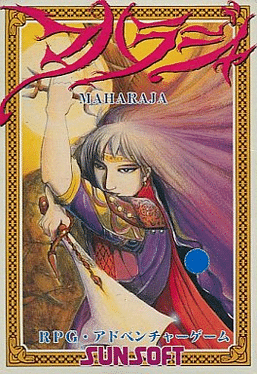
Famicom RPG released by Sunsoft in 1989. Set in ancient India, characters and events from Hindu mythology provide most of the game's backdrop.Meiji Ishin
1989
Meiji Ishin
1989
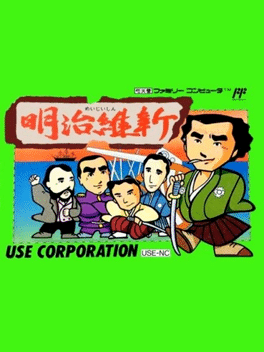
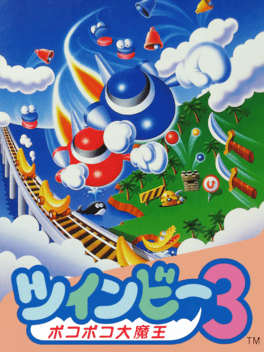
A Famicom adventure game set during the Meiji Restoration era. It features strategy and action elements as well. Meiji Ishin ("Meiji Restoration") is an adventure game for the Nintendo Famicom that allows the player to take an active role in one of the most important historical movements in Japanese history: the Meiji Restoration era of the late 19th century, which wrested control of the country from the Shogunate and back to the Emperor. The first half of the game is spent gathering allies which involves moving from region to region, conversing with leaders and samurai, and occasionally fighting enemies in duels. The second half gives way to a tactical strategy sim similar to Nobunaga's Ambition, as the player's recruited forces march on Edo (Tokyo) to take on the Shogun.TwinBee 3: Poko-poko Daimaou
1989
TwinBee 3: Poko Poko Daimaō is a vertical-scrolling shoot 'em up video game produced by Konami released for the Famicom. It is the third and last game in the TwinBee series for the Famicom and it ditches Stinger's horizontal levels making it more in line with the first title. The game is considerably easier than its predecessors due to an option mode that allows players to adjust the difficulty and number of ships, as well as the inclusion of the new "soul reviving system", which allows players to recover their power-ups after losing a ship. The game uses digitized PCM voice samples, particularly when the conga music in one stage chants "Poko Poko", and in the beginning of each stage, in which a voice proclaims the name of the stage. It was re-released on April 14, 2006 as part of the i-Revo downloadable game service.