New Family Computer Games - Page 43

Banana
1986
Banana
1986
The game takes place in a world called Banana Land, which is populated by anthropomorphic moles. Mr. Mole is on a picnic with his wife and son when an earthquake strikes, trapping his wife and son underground! Help Mr. Mole rescue his wife (and sometimes son) and find their way to the exit through underground areas of varying design. The game features 105 stages and a custom stage design mode. The object of each stage is to make it to the exit after picking up all the various food items and Mr. Mole's family members. There is no way to "die" as such, but the player can make a mistake and make a stage impossible to complete; for this reason the player can "give up" by pressing the A and B buttons simultaneously to re-try the stage.Musashi no Ken: Tadaima Shugyou-chuu
1986
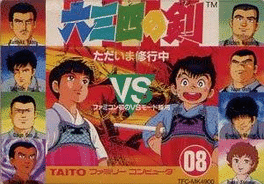
Musashi no Ken: Tadaima Shugyou-chuu is a 1986 video game software developed and published by Taito exclusively in Japan. It is based on a Japanese sports manga series written and illustrated by Motoka Murakami that focuses on kendo, simply titled Musashi no Ken. The gameplay and design in the one-on-one fighting parts resemble Taito's other fighting game, Great Swordsman, especially its kendo mode. The game's plot is about the son of two Kendo champions named Musashi. He strives to become as great at Kendo as his parents. The entire story centers around the world of Kendo and its up and coming competitors. The anime is broken up in to two parts. The first part follows Musashi's early years in grade school while the second part follows his high school years. In the first episode, Musashi befriends an Akita puppy who is by his side throughout the series.Hokuto no Ken
1986
Hokuto no Ken
1986
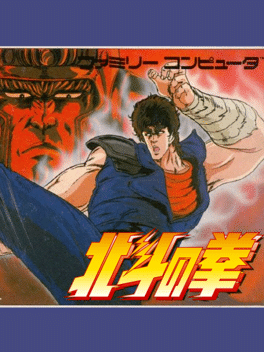
Hokuto no Ken for the Family Computer (Famicom for short) is a side-scrolling action video game published by Toei Animation and developed by Shouei Systems. It was released on August 10, 1986 exclusively in Japan and was the first of four Hokuto no Ken video games released for the Famicom. While it features gameplay similar to Sega's earlier Mark III version of Hokuto no Ken, it is an unrelated game made by a different developer.Choplifter
1986
B-Wings
1986
Bird Week
1986
Bird Week
1986
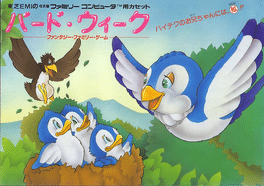
The player plays as a bird and can either play the normal game or the single level practice game. The player must feed butterflies to the baby birds so that they can grow big and eventually leave the nest. It is suggested that they eventually become the "new mother birds" that take care of their offspring in the subsequent levels. Finishing all 999 levels of Bird Week actually results in the beginning of an endless loop instead that ends when the players loses all of his lives. Each level represents a season in the ecosystem of a bird. The game starts out in early spring. As the virtual year progresses, the season evolves into summer and eventually into autumn. After autumn, the game repeats itself by portraying the following spring. If the proper amount of butterflies are not fed to the babies, then the babies end up starving to death. The player will automatically lose a life if any of the baby birds die. In addition to this, the player also loses a life when a predator catches the player trying to deliver butteKeisan Game: Sansuu 2-nen
1986
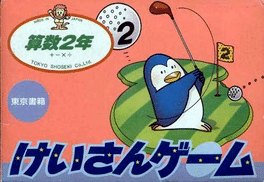
An educational math game for young Japanese students. The second in a series of five games released in 1986 by magazine giant Tokyo Shoseki.Keisan Game: Sansuu 1-nen
1986
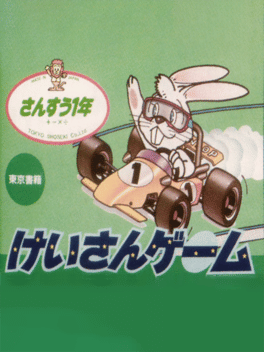
An educational math game for young Japanese students. The first in a series of five games released in 1986 by magazine giant Tokyo Shoseki.Keisan Game: Sansuu 3-nen
1986
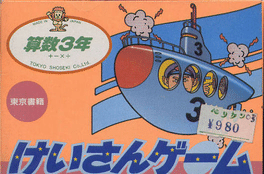
An educational math game for young Japanese students. The third in a series of five games released in 1986 by magazine giant Tokyo Shoseki.Argus
1986
Argus
1986
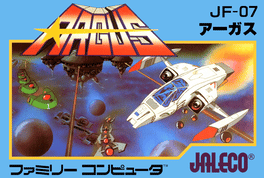
Argus is a vertical shooter by Jaleco and conversion of an arcade game originally released in 1986. The players takes control of a space-fighter equipped with a front laser gun and ground bombs. Although the game features power-ups, they follow an unusual and unique formula - tiles on the ground must be destroyed in order to upgrade the main weapon or trigger special events. However, three of these tiles must be destroyed to activate such power-ups - B creates a temporary barrier around the ship,P upgrades the primary weapon and L gives the player an extra bonus at the end of each stage. Another interesting twist to the game is the Uoru armor; a shadow sometimes appear on the ground and if the player aligns his own shadow with it, then the ship transforms into a powerful robot for a short amount of time. Each stage ends with the same boss battle; a large Mega Argus fortress with a slow flashing core at its center, and the only way to destroy this pernicious mothership is to bomb its core when it is fully exposed. AGeGeGe no Kitaro: Yokai Daimakyou
1986
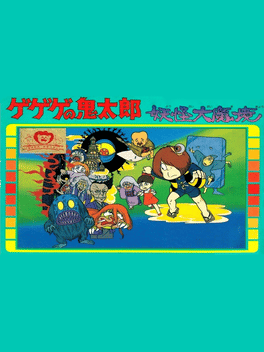
GeGeGe no Kitaro: Yokai Daimakyou, known as Ninja Kid in the West, is an NES game developed by TOSE and published by Bandai. It was based on the manga series GeGeGe no Kitaro. This game was followed by a sequel titled Gegege no Kitarou 2: Youkai Gundan no Chousen, which was released the following year only in Japan also by Bandai. It was the eighth best selling Famicom game of 1986, selling 1,250,000 copies. The original Japanese version is notably different from the American version (Ninja Kid). The main character is Kitarō, and his main weapon is his hair rather than darts. His sub-weapons are a flying finger instead of shuriken, his vest instead of the feather, and a geta instead of a boomerang. All of these weapons function the same as the ones of the protagonist of the American version, Kyo; they just use different sprites. The fireball sub-weapon remains the same. Certain levels are inhabited by "western" film monsters like Frankenstein's Monster and Count Dracula; the boss of these levels is the characterBaltron
1986
Baltron
1986
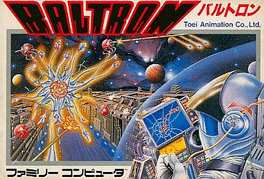
Baltron is an Action game, developed by Shouei and published by Toei Animation, which was released in Japan in 1986.Ninja Hattori-kun
1986
Ninja Hattori-kun
1986
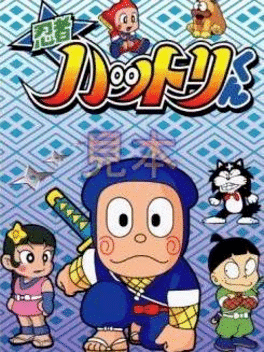
A side-scrolling action platformer based on Fujiko Fujio A's manga series of the same name, which later became an anime series. The game was released around the same time the anime was aired.Gyrodine
1986
Gyrodine
1986
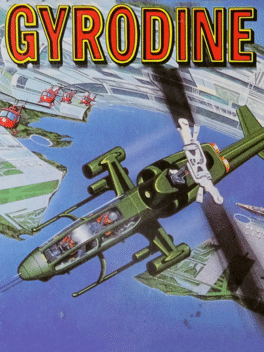
Gyrodine is a top-down vertical helicopter scrolling shooter for the Nintendo Entertainment System/Family Computer, MSX and arcade developed by Crux and published by Taito in 1984.Zunou Senkan Galg
1986
Zunou Senkan Galg
1986
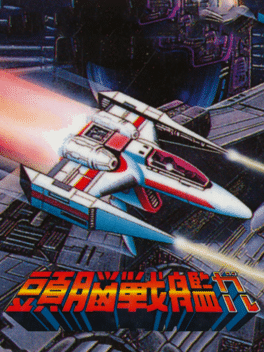
Zunou Senkan Galg ("Brain Battleship Galg"), referred to as just Galg by the game's title screen, is a vertical-scrolling shoot-em-up in which the player must navigate a serious of canyon-like environments for missing pieces to a war machine. Each stage has at least one piece, so the player must visit them all in order to find the necessary number. In addition to this, there are numerous secrets hidden throughout the many stages of the game, and the player frequently has to choose between multiple paths which lead to different stages. The game advertises itself as a "RPG" on its box art, referring to this additional layer of complexity. Like The Tower of Druaga, it is considered a historically important game in Japan for the amount of secrets and mysteries it contains and the subsequent difficulty involved in reaching the end without this hidden knowledge. Therefore, it was one of the earliest games for the Famicom to feature its own printed game guide for players to follow. Zunou Senkan Galg is almost entirely unHottaaman no Chisoko Tanken
1986
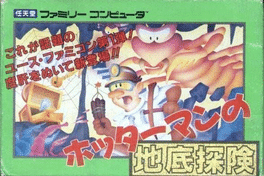
Players get to dig up dirt beneath the surface, find keys behind four doors, and then find the door to the next level. The most obvious game to compare it to is Dig Dug, but without the boulders and with various devices like teleporting doors, speed, dynamite, and a wet suit. There are 15 levels in the entire game; which repeat themselves after the 15th level is finished. Lava can spew out at a vertical direction towards the player and kill him; it does not reset itself even after the players loses a life (but it does reset itself after a game over) Passwords are activated by pressing a certain button combination on the password screen. Several passwords results in cheat codes that does certain things; such as deactivating the lava in all levels of the game. Certain type of blocks are worth different points once they are dug up; ranging from common dirt to destructible blocks. The game features an instant death clause where players die in a single hit. Killed enemies reappear at the same location where they wereAbyss of Gloom
1985
Onyanko Town
1985
Onyanko Town
1985
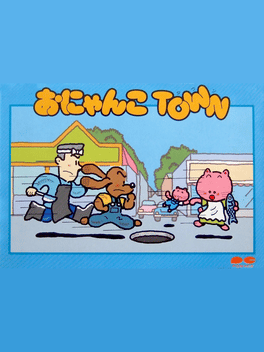
Players must play the role of a mother cat called Milky who lives in a dangerous metropolis full of dogs. The dogs want to kill Milky before she can rescue her son Michael who wandered out into the city on his own (and became lost). Players must catch the fish for temporary invincibility. However, the other enemies can still kill the mother cat like the fish merchant (who is the only humanoid bad guy in the game), the automobiles on the road, along with the manholes and the pylons. The city is divided into roads for automobile traffic and sidewalks for roaming pedestrian dogs in overalls. The fish merchants completely replace the dogs after the 30th level; causing the invincibility icon (fish) to become redundant. Unlike the Teenage Mutant Ninja Turtles series of video games (especially the first NES release which would come out four years later in 1989), open manholes kill the player instead of helping her evade the roaming dogs. Sewer snakes also come out to kill the player with its poisonous venom. Triangle conRoute-16 Turbo
1985
Route-16 Turbo
1985
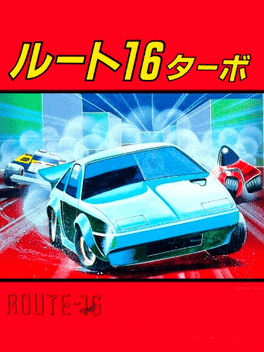
Route-16 Turbo is an improved version of Route-16 for the Famicom which was published on October 4, 1985 by Sunsoft only in Japan. Route-16 Turbo added multiple difficulty levels and improved graphics and music. In Route-16 Turbo, players get behind the wheel of a car and drive around trying to collect valuable items lying around on the road while avoiding chase cars whose only purpose is to crash into the player's car. In the game, the player's car drives around on a map that contains a bird's eye view of the 16 different routes (individual maze rooms) that can be entered. This overhead map screen shows which routes contain the items that have to be collected. Each item the player collects will increase their score. Collecting all the items in a level will allow the player to go on to the next round. When the player enters a specific route, the game switches its view to a single screen maze. These mazes contain dead-ends, zig-zags, multiple exits, enemy obstacles, with also the the threat of the chase cars ente