New Arcade Games - Page 47

Dynamite Bomber
2000
Dynamite Bomber
2000
A challenging platform game from Limenko that has many different stages and bosses including a giant robot on the moon. Dynamite Bomber was produced by Limenko in 2000. Limenko released 5 different machines in our database under this trade name, starting in 2000. Other machines made by Limenko during the time period Dynamite Bomber was produced include Happy Hunter, Battle Bubble, Legend of Heroes, and Techno X.beatmania Club MIX
2000
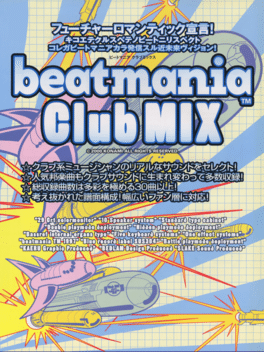
beatmania Club MIX
2000
beatmania clubMIX is a rhythm game developed by Konami. It is the eighth game in the beatmania series and is part of the BEMANI franchise. The game is played with a controller with one turn table and 5 keys, three white and two black. On the screen you will see bars moving from the top to bottom in columns representing each of the keys and the turntable. When the bars reach the judgement line it is time to scratch. The songs from completeMIX 2 were downgraded in difficulty section, HARD charts became NORMAL charts and ANOTHER charts became HARD charts. No changes was made to the charts themselves. The new ANOTHER charts added to the game were not ranked, even though completeMIX 2 started ranking ANOTHER charts. beatmania clubMIX is a release where the focus is to have as much licensed club songs as possible. Therefore, only 10 Konami made songs from beatmania completeMIX 2 return in the game, with 7 new original songs made for the game. The remaining 14 songs are all licensed songs. Total amount of songs in thePop'n Music 4
2000
beatmania III -The latest evolution machine-
2000
beatmania III is a rhythm game developed by Konami. It is the first game in the beatmania III series, a spin-off of the beatmania series. It is part of the BEMANI franchise. The game is played with a controller with one turn table, one foot pedal and 5 keys, three white and two black. On the screen you will see bars moving from the top to bottom in columns representing each of the keys, foot pedal and the turntable. When the bars reach the judgement line it is time to scratch. This game starts the beatmania III spinoff series, which introduces the foot pedal into the game, which has separate notes tied to it. The foot pedal can also be configured to act as one of the 5 regular keys as well. Since the series features upgraded hardware in comparison to the main series, the game has more fluid movies and animation and the interface is generally more colorful. The effector table is also expanded. The cabinet has a floppy disk slot on which you can save scores, unlocked songs and game modes. A headphone jack is alsoPop'n Music: Mickey Tunes
2000
pop'n music MICKEY TUNES is a pop'n music spin-off containing exclusively Disney related music, much like DanceDanceRevolution and its spin-offs. It was later directly ported to consoles as pop'n music Disney TunesPop'n Music Animelo
2000
Pop'n Music Animelo
2000
Pop'n Music Animelo (Pop'n Music アニメロ) is a rhythm video game developed by Konami and released on Arcade platforms in March 2000 in Japan. The game was later released on PlayStation under the name Pop'n Music: Animation Melody in July 2000 in Japan. It is a spinoff entry in the Pop'n Music series.Fighting Mania: Fist of the North Star
2000
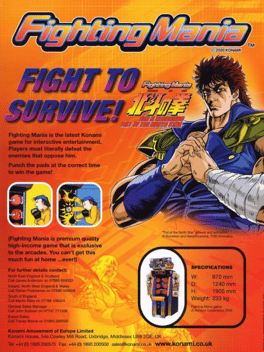
This was an arcade game released in 2000 by Konami (also known as Punch Mania: Hokuto no Ken)Guts'n
2000
Knights of Valour 2
2000
Slashout
2000
Slashout
2000
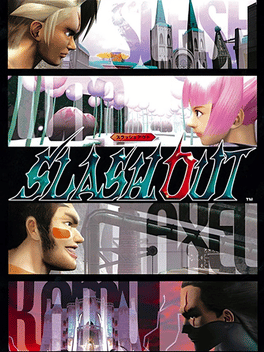
Slashout is the third installment to the Spikeout series, released for Sega NAOMI hardware in 2000. Unlike other games in the series, Slashout has a completely different setting, based in a fantasy world with different characters—gameplay remains similar, however.Head Panic
2000
Head Panic
2000
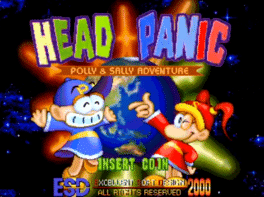
A platform game in which you throw balls to kill the enemies. Very similar to the Snow Bros. S.agabeatmania complete MIX 2
2000
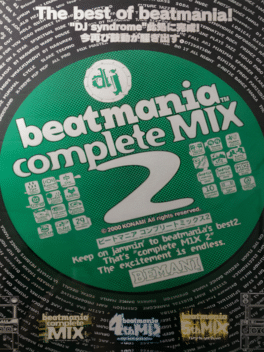
beatmania completeMIX 2 is a rhythm game developed by Konami. It is the seventh game in the beatmania series and is part of the BEMANI franchise. The game is played with a controller with one turn table and 5 keys, three white and two black. On the screen you will see bars moving from the top to bottom in columns representing each of the keys and the turntable. When the bars reach the judgement line it is time to scratch. Difficulty levels were rearranged on a scale from 1 to 9, which remains as the standard for the rest of the series. Many older songs have new ANOTHER difficulty charts, some have a rearranged charts for their ANOTHER charts, making use of the preexisting assets to make a new sounding song. The HARD version charts from 5thMIX became ANOTHER charts in this version. The modifier CENTER PLAY has been added, making it possible to use the 2 player keys and 1 player turntable, for scratching with the left hand. HI-SPEED has been expanded with 2x-4x selection. beatmania completeMIX 2 is a compilationDead or Alive 2 Millennium
2000
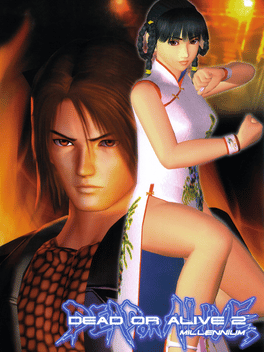
Dead or Alive 2 is a fighting game in the Dead or Alive series, developed by Team Ninja and published by Tecmo. It debuted in arcades in 1999 and was later ported for the Dreamcast and the PlayStation 2 in 2000. Several enhanced editions of the game were released, including the updates Dead or Alive 2 Hardcore and Dead or Alive 2 Hard*Core. Dead or Alive 2 improved upon the graphics engine of its predecessor by using Sega NAOMI hardware and on the gameplay system by including many new features, leading to critical acclaim and strong sales. In 2004, DOA2 was remade for the Xbox as part of Dead or Alive Ultimate.NFL Blitz 2000: Gold Edition
2000
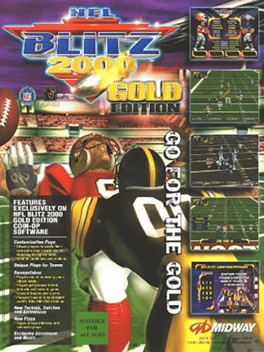
Players choose an official NFL team, each with unique statistics, and compete in American football games with very few real-world rules. The object of the game is to try and win the Superbowl! This title uses the latest in 3DFX graphics.Mission Craft
2000
Mission Craft
2000
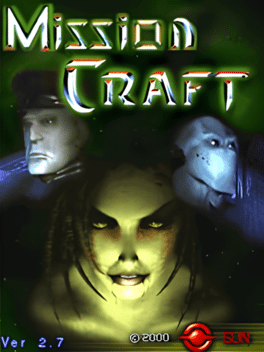
An arcade shoot-em-up that repurposes assets from StarCraft and Warcraft II, Mission Craft has players choose between terran, protoss, and zerg ships to blast their way through enemy bases.Gals Panic S2
2000
Funny Bubble
2000
Funny Bubble
2000
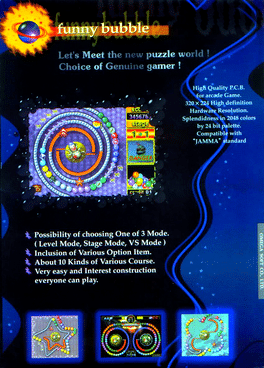
Color balls goes into spiral tube and you need to match 3 balls before the first ball enters the core.Rock'n Tread
1999
Rock'n Tread
1999
Rock'n Tread is an arcade game developed and published by Jaleco, released in Japan in July 1999.Search Eye Plus V2.0
1999
Search Eye Plus V2.0
1999
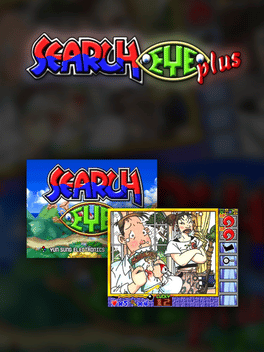
A competitive puzzle game for 1 or 2 players released only in South Korea by Yung Sung Electronics.SpikeOut: Final Edition
1999
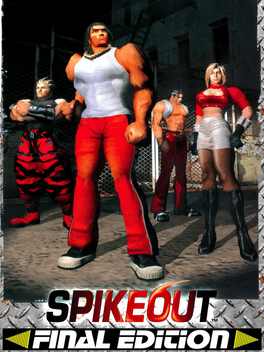
Spikeout: Final Edition is the 1999 update for Spikeout: Digital Battle Online, and the second in the Spikeout series of arcade games. It replaces the game's attract sequence, balances out the characters, adds 2 new stages and bonus stages, and adds a cutscene explaining the backstory of the game's villain Mikhael.