New Games - Page 13620

Pacar
1983
Pacar
1983
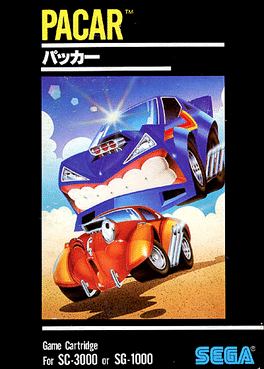
Pacar is an SG-1000 game initially released in 1983. It is essentially a mix between two Namco games; Pac-Man and Rally X. It is the sequel to Head-On, which was released a year before Puck-Man. However, Pacar is more-so a clone of Puck-Man than a true Head-On sequel. The player controls "Pacar", a "mischievous" green car through a maze of roads. The objective of the game is to "delete" all of the small red "dots" scattered around the playfield, building up points for a high score. The joystick allows Pacar to move in the proposed direction, assuming it is possible to do so. Like Pac-Man, Pacar does not stop moving unless it hits a wall, however unlike Pac-Man, it is not possible to rotate 180 degrees on the spot - moving in the opposite direction causes Pacar to reverse, and reversing is significantly slower than driving normally. Ideally the player should plan his or her route to avoid reversing altogether. 1 or 2 allows Pacar to move faster across the board. Driving off the edge of the screen makes PacaChack'n Pop
1983
Chack'n Pop
1983
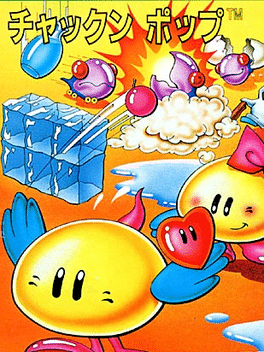
Chack'n Pop is considered a predecessor of Bubble Bobble. It is a platform game where a roundish yellow creature, named Chack'n, must fight against Monstas and Mightas in order to reclaim hearts that were stolen during a romantic encounter with Miss Chack'n. The Monstas themselves hatch from eggs hanging from the ceilings and the Mightas push a rock that is used as the game's timer. The Monsta eggs have three phases: if it's blue, it's completely harmless, if it's yellow it will pop within 10 seconds and if an egg turns red it will pop almost immediately. Chack'n uses bombs to blow up the Monstas and their eggs and he also uses them to release the captured hearts from their cages. When the heart is released, it will fly up and destroy the separator block and reveal the exit to the level.Drol
1983
Drol
1983
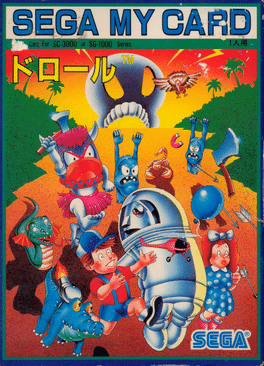
Drol is an SG-1000 game released in 1985. Originally developed by Brøderbund for various home computers in the west, it was brought to the SG-1000 by Sega and released exclusively in Japan. You play as a robot who must rescue his children.World Series Major League Baseball
1983
World Series Major League Baseball is a baseball sports game that supports both ECS and Intellivoice (for play by play announcements). The game is based on real baseball player statistics (even though the names had been changed to fictional ones before the release) and offers baseball games using multiple cameras (including in-game split-screen), showing the game in a 3D display rather than side-scrolling fashion.Tron: Solar Sailer
1983
Tron: Solar Sailer
1983
TRON: Solar Sailer is a game based on the 1982 Disney movie TRON, released for the Intellivision that same year.Masters of the Universe: The Power of He-Man
1983
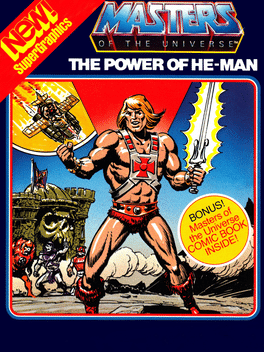
You have to free Eternia from the clutches of Skeletor.Kool-Aid Man
1983
Kool-Aid Man
1983
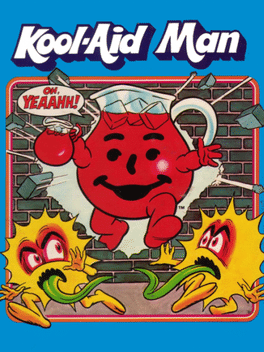
Help Kool-Aid Man in a battle with the Thirsties! Those insatiable Thirsties are stealing the water out of your swimming pool. You want to catch em when they stop to dip their straws in the pool. Also, help Kool-Aid Man gobble up Kool-Aid ingredients in order to keep the Thirsties from bouncing Kool-Aid Man around the backyard.The Dreadnaught Factor
1983
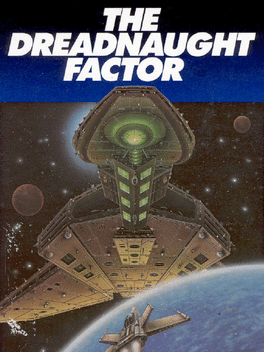
"Oh dear." The scene: Space. The cosmic edge. Never deeper, never darker. The Home Team: A Stargate. A squadron of Hyperfighters. A glittering, pulsating sea of unstable energy. (Please--no quick or sudden movements.) The Challengers: Dreadnaughts. We're talkin' size LARGE. Behemoths. Invincible. Or so some say. You succeed: Universal applause. Life in the fast lane. Early retirement. Endorsements. You name it, it's yours. You fail: Not a viable alternative. You want I should draw you a picture? Distinctly unpretty. The Big Zip. Kaput. Finito. Capice?Congo Bongo
1983
Congo Bongo
1983
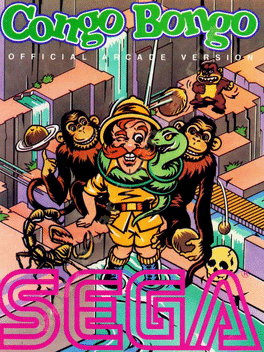
Commodore VIC-20 ColecoVision Arcade Atari 2600 Atari 8-bit Commodore C64/128/MAX Intellivision Atari 5200 DOS Apple II Texas Instruments TI-99 MSXstar 7.1Congo Bongo is an isometric platform arcade game released by Sega in 1983. The game has come to be seen as Sega's answer to the highly successful Donkey Kong game that was released two years prior. The player takes the role of a red-nosed safari hunter who tries to catch an ape named "Bongo". The hunter seeks Bongo to exact revenge for an apparent practical joke in which Bongo set fire to the hunter's tent, giving him a literal "hotfoot". The game was named by Peter W. Gorrie who was the CFO of Sega at that time.Advanced Dungeons & Dragons: Treasure of Tarmin
1983
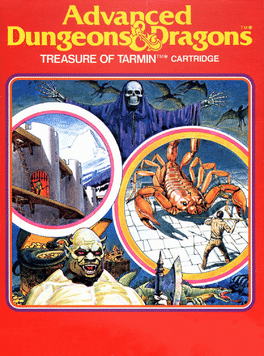
In Treasure of Tarmin the player wanders through a multi-tiered dungeon, each level consisting of a maze and its surrounding hallway. The objective is to slay the Minotaur who guards the Treasure of Tarmin and take his treasure.MotoRace USA
1983
MotoRace USA
1983
MotoRace USA is a basic arcade motorcycle racing game that alternated between a bird's eye view and an over the shoulder view throughout the race. The player controls a racer who must travel on a motorcycle from Los Angeles to New York City.Nuts & Milk
1983
Nuts & Milk
1983
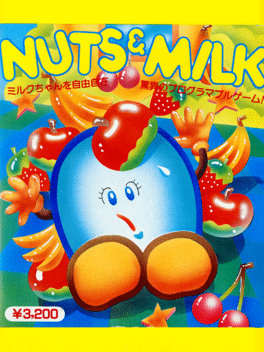
PC-8800 Series Commodore C64/128/MAX Sharp X1 Nintendo 3DS Wii Family Computer Wii U FM-7 NEC PC-6000 Series Nintendo Entertainment System Legacy Mobile Device MSXstar 6.4Nuts & Milk is a platform-style puzzle game developed and published by Japanese software developer Hudson Soft in 1983. The game was released initially on the FM-7, MSX, NEC PC-8801, NEC PC-6001, and later to the Famicom in Japan. It was the first third party video game to be released on a Nintendo console.Antarctic Adventure
1983
Antarctic Adventure
1983
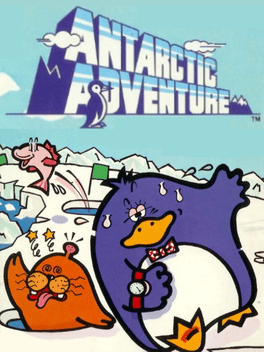
star 6.4Antarctic Adventure is a video game developed by Konami in 1983 for MSX, and later for video game consoles, such as NES. The player takes the role of an Antarctic penguin, racing to disparate research stations owned by different countries in Antarctica. The gameplay is similar to Sega's Turbo, but plays at a much slower pace, and features platform game elements. The penguin, later named Penta, must reach the next station before time runs out while avoiding sea lions and breaks in the ice. Throughout the levels, fish jump out of ice holes and can be caught for bonus points. The game, like many early video games, has no ending – when the player reaches the last station, the game starts from the first level again, but with increased difficulty.Oubliette
1983
Oubliette
1983
Oubliette is the ultimate fantasy role playing game. The user is allowed to run a party of up to six players through life in a fantasy castle and adventure in the dungeon which resides beneath.Snoopy and the Red Baron
1983
star 4.8The dastardly Red Baron has stolen important food supplies from the allies during the war. Hamburgers, ice cream cones, popcorn and other tasty treats have been taken by this evil aviator and sharpshooter. Your task is to help Snoopy shoot down the Red Baron and recover the stolen supplies. You begin your mission with four doghouses. It takes eight direct hits to bring down the Red Baron, and for the Red baron to bring down Snoopy's doghouse. If the Red Baron downs a doghouse, all accumulated treats will be lost. Press the controller button to fire Snoopy's machine gun.Bedlam
1983
Bedlam
1983
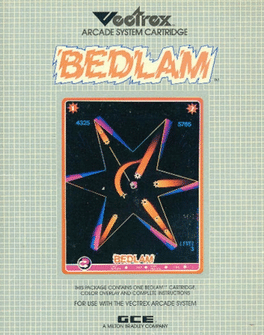
star 8In the arcade game Tempest, players controlled a blaster that could move around the outermost lanes of a bunch of geometrically-shaped levels and fire at ships that emerged from the middle or innermost areas of those levels. Bedlam, however, was a "Tempest in reverse", where players' ships (resembling the Millennium Falcon from several of the Star Wars movies) sat in the middle of sectors while ships emerge from points of those sectors and came inwards towards the player. Players turn their ships left and right and can spin them around quicker with the Fast Rotate button. Also, Zap, like the Superzapper on Tempest, will destroy everything onscreen and can only be used once per sector. There are several different types and mannerisms of enemies as well as sectors. Getting rammed by an enemy will cause the player to lose a ship in reserve and the game will end once the player has no more remaining ships.Art Master
1983
Art Master
1983
The Light Pen is an accessory for the Vectrex released in 1983 by GCE. It was quite revolutionary for its time, but because of the Great Video Game Crash of 1983, it ended up as a commercial failure. Packed in with the accessory was the game Art Master. During its lifetime, GCE managed to release three games for it: Art Master, Melody Master and AnimAction. There was also a prototype, Mail Plane, that never managed to get a release.AnimAction
1983
AnimAction
1983
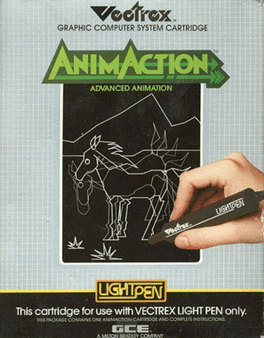
AnimAction is one of the Vectrex titles that requires the light pen accessory to operate. The light pen pack-in cartridge Art Master, only had rudimentary animation capabilities... AnimAction takes animating your vector based artwork to another level. An interesting fact about the AnimAction cartridge is that it is not an any of the the aftermarket multi-carts because it had extra memory built in to save your artwork, making it a more desirable program cartridge for your Vectrex collection. let's face it... there is something cool about seeing your own art moving about on the screen of a gaming console that is over a quarter century old! This is one of the software releases where GCE broke out of the "games only" mold and endeavored to make more interactive and educational programs for this awesome vector based platform.3D Narrow Escape
1983
3D Narrow Escape
1983
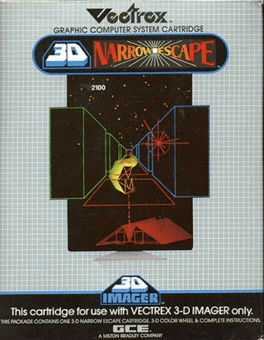
The goal in 3D Narrow Escape is to successfully navigate a ship through the narrow, fast-moving passages of the warlord's fortress, destroy the defense forces and avoid space debris. The player's ship must also be maneuvered through small holes in a series of walls where fuel cells can be picked up to restore the ship's constantly decreasing fuel supply. If the player pilots their ship successfully, they will be faced with the warlord's own escape ship which must be hit several times to be destroyed, liberating the star system from the warlord's tyranny. Each level becomes more difficult as everything will move faster, fuel will be consumed more quickly, the holes in the walls will become smaller, and more menacing defense forces will appear. Each level of game play consists of two phases: 1. Passages: During the first phase of each level, the player must maneuver their ship through the narrow, moving passages with the joystick while shooting six of the warlord's defense forces with button 4. If any of theLilly Adventure
1983