New Dos Games - Page 62

Jacaranda Jim
1987
Jacaranda Jim
1987
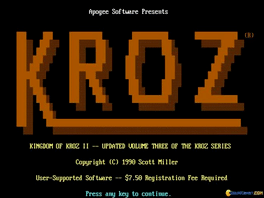
Following an attack on his cargo-ship by an army of homicidal beechwood armchairs Jacaranda Jim is forced to crash land on the strange world of Ibberspleen IV. Rescued from the burning wreckage by the mysteriously smug Alan the Gribbley, Jim has to do battle with manic-depressive deckchair attendants, the Ibberspleen Post Office and a very sinister network of dank caves. What is the secret of the floating sphere? Why has Alan been hypnotized? What would you do with a cucumber, a gin-spitting pirate and a piece of gristle? No, don't answer that.Kingdom of Kroz II
1987
Aldo's Adventure
1987
Aldo's Adventure
1987
A jumping arcade game. You control Aldo character and your goal is to leave every level while avoiding obstacles and enemies.The Seven Spirits of Ra
1987
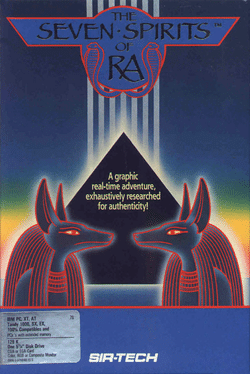
A graphic real-time adventure, exhaustively researched for authenticity! Journey back over 3,000 years to participate in this authentic drama accurately recreating the ancient Egyptian myth. Time: Eleventh year of the reign of the Pharaoh Osiris. Location: Upper and Low Kingdoms of Egypt. Villains: Set, the God of Darkness and Harumheb, the High Priest. Crime: Osiris is slain, on Set's instructions by Harumheb, aboard the royal barge. Set tears the body of Osiris into pieces and scatters it far and wide, where it is consumed by wild beasts and birds. Problem: The souls of Osiris are banished to the frightful wastes of the Land of the Dead. Your task: Accept the challenge to save the scattered souls of Osiris- his Seven Spirits of Ra.First Expedition
1987
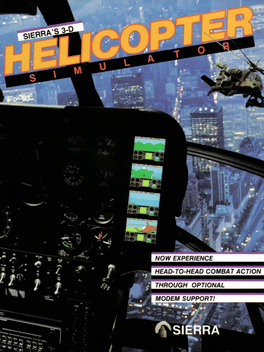
Sierra's 3-D Helicopter Simulator
1987
In 3-D Helicopter Simulator, fly the McDonnell Douglas AH-64A Apache attack helicopter. The game allows the player to fly over various locations, or play in a target practice and combat modes. Two players can compete via a modem.ACE
1986
Summer Games II
1986
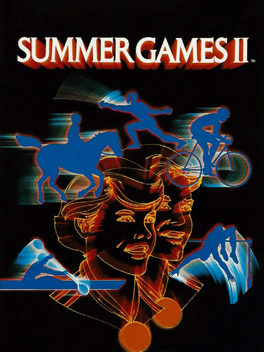
Summer Games II
1986
The DOS port of Summer Games II features only PC Speakers as audio, and CGA graphics. Another notable thing is that the game is bootable from disk.Winter Games
1986
Batalia
1986
Batalia
1986
This two-player, ASCII-based arena combat game has a backstory: you and your co-pilot have been busted by Galactic police for smuggling illegal goods. As it turns out, Galactic justice doesn't screw around, and in a touch of Imperial Roman flair, you've both been tossed into a labyrinth to duke it out with each other gladiator-style. Only one will emerge alive. Each player is given a ship, which can shoot in four directions at once. The arena's layout changes on every round, but the premise remains the same - maneuver your combat ship around the playing field, use the walls for cover, and kill your opponent. The first player to win ten rounds will emerge victorious.The Red Baron
1986
The Red Baron
1986
The Red Baron is a single player game in which the player flies a bi-plane in a fixed side-scrolling environment.Beyond the Titanic
1986
Beyond the Titanic
1986
As the game begins you find yourself standing on board the Titanic, on her maiden voyage. Of course, that particular voyage was never completed! Your goal is to survive and somehow get back to your home in the United States. Most of your time will be spent solving numerous problems and dangers that arise, like starvation and drowning. If you've played any of Infocom's famous text games you will notice that Beyond the Titanic is quite similar to Zork and Planetfall.Larn
1986
Swords of Glass
1986
Leygref's Castle
1986
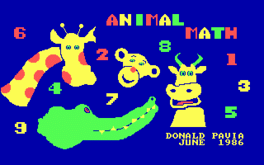
Animal Math
1986
Clock Game
1986
Clock Game
1986
An educational game that teaches kids how to read an analog clock programmed by Donald L. Pavia