Red Baron is an arcade game developed by Atari, Inc and released in 1980. A first-person flight simulator game, the player takes the role of a World War I ace in a biplane fighting on the side of the Allies.
Warlords is an arcade game released by Atari, Inc. in 1980. The game resembles a combination of Breakout and Quadrapong (an early Atari arcade game) in the sense that not only can up to 4 players play the game at the same time, but also the "forts" in the four corners of the screen are brick walls that could be broken with a flaming ball. Warlords uses spinner controllers for player control, and came in both an upright 2 player version and a 4 player cocktail version. The upright version uses a black and white monitor, and reflects the game image onto a mirror, with a backdrop of castles, giving the game a 3D feel. The upright version only supports up to two simultaneous players, which move through the levels as a team. The cocktail version is in color, and supports 1-4 players. 3-4 player games are free-for-all's where the game ends as soon as one player wins. 1-2 player games play identical to the upright version.
N-Sub is one of the earliest naval video game titles.
The object of the game is to maneuver an on-screen submarine, the "N-Sub," with the joystick and sink the enemy fleet with torpedo fire in the Cobalt Blue Sea. Torpedoes can be fired vertically or horizontally by means of two separate 'FIRE' buttons and 3 torpedoes can be fired in rapid succession by keeping the button depressed. The enemy ships attack the N-Sub with missiles, torpedoes and depth charges. One round is over after the attack by the enemy fleet of twelve ships (No. 1 Fleet Black, No. 2 Fleet Blue) and the loop attack by the enemy destroyer. Enemy attack gains in ferocity with each new round. Bonus points are awarded if the fleet of twelve ships and the destroyer are destroyed. One extra N-Sub is added if players attain high score. The game is over when all of a player's N-Subs are sunk.
Men are lined up the right side of the screen and alien ships fly out, swirl around the screen and eventually try to grab the men. This was one of the first all color graphics games and might be the first one that used speech. Some of the phrases are "Help Me! Help Me!", "Very Good", "We'll be back" and "Lucky!"
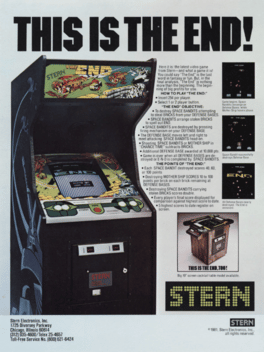
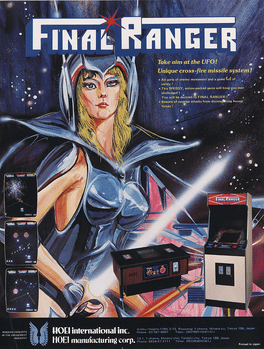
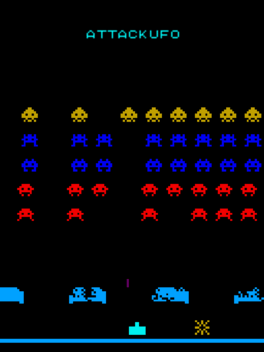
In this shoot 'em up the player has to fight off four assault waves consisting of different enemy types until he reaches a huge UFO. After destroying the protective plates guarding the UFO's pilot in his cockpit the player can kill the pilot. The game starts anew with harder enemies.
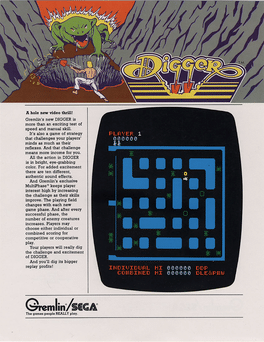
Maneuver your humanoid through the electrified mazes of robot filled rooms. You many kill off the first group of robots but initial success does not mean survival...future groups begin firing at your! Added danger lurks when Evil Otto enters. He can jump the maze walls and squash you if you linger too long!
A military simulation version of Battlezone. You do not control the tank, just the turret. Enemy tanks do not fire at you. The only way to lose is to run out of ammo or shoot a friendly tank.
Radar Scope is a 1980 fixed shooter arcade game developed by Nintendo R&D2 and published by Nintendo. The player assumes the role of the Sonic Spaceport starship and must wipe out formations of an enemy race known as the Gamma Raiders before they destroy the player's space station. Gameplay is similar to Space Invaders and Galaxian, but set in a forced perspective angle.
Radar Scope was a commercial failure and created a financial crisis for the subsidiary Nintendo of America. Its president, Minoru Arakawa, pleaded for his father-in-law, Nintendo president Hiroshi Yamauchi, to send him a new game that could convert and salvage thousands of unsold Radar Scope machines. This prompted the creation of Donkey Kong. Radar Scope is one of the first video game projects for artist Shigeru Miyamoto and for composer Hirokazu Tanaka.
Retrospectively, critics have praised Radar Scope for its gameplay and design being a unique iteration upon the Space Invaders template. One critic labeled it one of Nintendo's most important ga
HeliFire is a Nintendo developed and published arcade video game released in America and Japan in 1980. The game gives you the unfortunate task of controlling a submarine that is under fire by a host of helicopters and even marine wildlife. As the submarine, you must dodge the bombs that the helicopters drop as well as the sea creatures and shoot upwards at the oncoming onslaught of enemies, delivering your fire a little ahead of the helicopter so that it connects in time. Interestingly, a version of the game was planned for the Nintendo Entertainment System, though was for whatever reason canceled by Nintendo. The game was presented in both a standard cabinet form and as a tabletop title.
Exciting Space Game! Mysterious Enemies Attack The Earth! Players' Beam-Cannon can be moved from side to side by the lever. Beams to destroy 'Andromeda-Ships' are fired by pressing the button. When all 'Andro-Ships' are destroyed, a new screen image of all ships will appear again. Bonus points shown at the bottom of the screen will be added to player's total points, as player resumes the game.
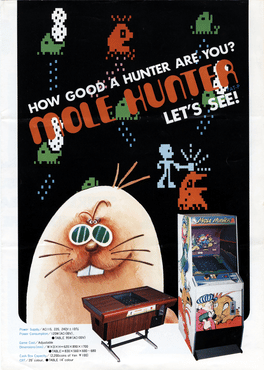
You control a big-game hunter who must use a tranquilizer gun to stun animals like snakes, elephants, gorillas and lions. The hunter must also bring the animals back to his truck.
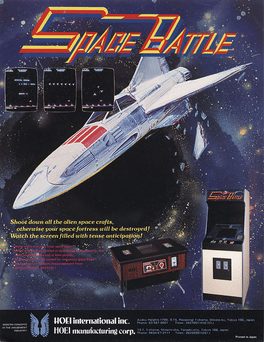
To put it in simple terms, if it moves and it is not your ship, destroy it. This game follows in the same vein as many of the early 1980's space shooters.
Viewed from above, the player drives a race car through the twisting curves and straightaways of a moving track. The player can select between eight different tracks. Higher numbered tracks have more turns and narrow sections.
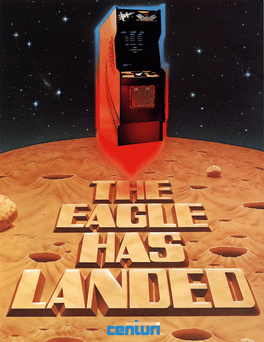
Alien spaceships from another planet attack New York City and threaten to conquer the world. You must use your laser cannon to save the city by destroying the Mother Ship and her fleet. Speech: "Come On!", "Hit Me, Hit Me!" and "I'm Here!".