Most Popular Famicom Games - Page 33

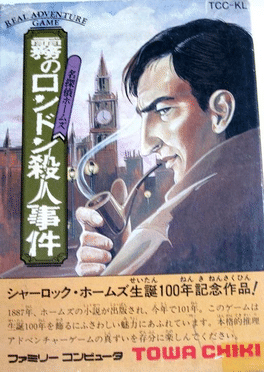
Meitantei Holmes: Kiri no London Satsujin Jiken
1988
An adventure game starring Sir Arthur Conan Doyle's Sherlock Holmes developed for the NES by Towa Chiki. Meitantei Holmes: Kiri no London Satsujin Jiken ("Great Detective Holmes: Fog of London Murder Case") is a murder mystery adventure game where the player directs Sherlock Holmes around London, finding clues and interrogating witnesses and suspects. Like its many NES adventure game contemporaries, it adheres to the Portopia formula of text adventure whodunits. It is the sequel to Towa Chiki's earlier Sherlock Holmes game (Sherlock Holmes: Hakushaku Reijou Yuukai Jiken) and received a sequel (Meitantei Holmes: M-Kara no Chousenjou). None of these games were ever released outside of Japan.Meitantei Holmes: M kara no Chousenjou
1989
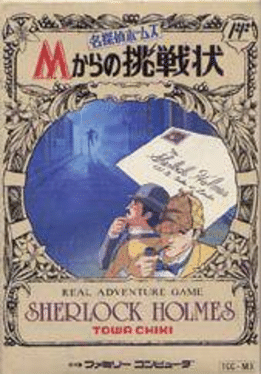
The third of three NES Sherlock Holmes adventure games from Towa Chiki and Another. M-Kara no Chousenjou is the third in Another/Towa Chiki's series of adventure games for the Famicom that star Sir Arthur Conan Doyle's famous sleuth, Sherlock Holmes. It follows Sherlock Holmes: Hakushaku Reijou Yuukai Jiken and Meitantei Holmes: Kiri no London Satsujin Jiken. As with the second of those games, M-Kara no Chousenjou has the player navigate a menu to talk to NPCs and witnesses, investigate areas of interest, find and pick up evidence and walk to various locations across Victorian-era London and other cities.Mezase Pachi Pro: Pachio-kun
1987
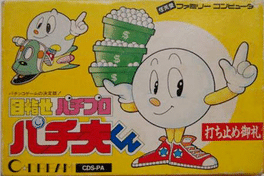
The first game to feature Pachio-kun, the mascot for a series of pachinko-themed games by Coconuts Japan, Mezase Pachi Pro: Pachio-kun ("Aiming For Pachinko Pro: Pachio-kun") is simply a virtual pachinko hall with 72 different machines on which the player may try their luck. The game rewards attentive pachinko veterans by having several of the machines possess quirks, such as the frequency of payouts, certain pins being bent that will favor a ball's route to the bottom and the like. Pachio-kun simply has to lean in to examine the machines closer to ascertain how to make the machine pay out. The overall goal is to keep playing each machine, winning either through a determined strategy or simple perseverance, until all the machines have been emptied of their contents. Doing so will win the game.Mezase! Top Pro Green ni Kakeru Yume
1993
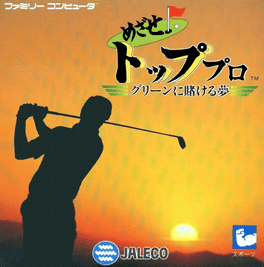
Mezase! Top Pro Green ni Kakeru Yume is a Sports game, developed and published by Jaleco Entertainment, which was released in Japan in 1993.Mito Koumon II: Sekai Manyuu Ki
1988
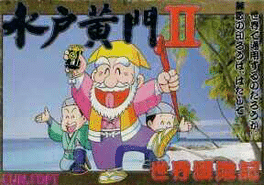
A NES action game developed by SunSoft and the sequel to Mito Koumon. It was never released outside of Japan. Mito Koumon II: Sekai Manyuuki is the sequel to Mito Koumon and is very similar in appearance and gameplay. As in that game, the player controls one of Mitsukini Tokugawa's retainers as they gather clues and evidence of crimes in the area while either avoiding or fighting off hostile NPCs. Unlike the first game, which was set entirely within Japan, Tokugawa is crossing the world solving issues instead. The first stage is America (specifically the Wild West, as would be chronologically accurate for the 17th century) though there are plenty of other locations to visit across the world as well, including even Transylvania.Mizushima Shinji no Daikoushien
1990
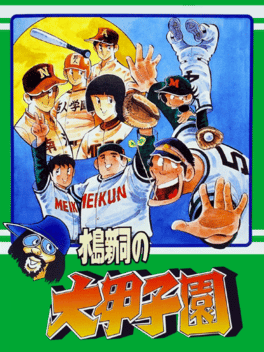
Mizushima Shinji no Daikoushien is a Sports game, published by Capcom, which was released in Japan in 1990.Momotaro Dentetsu
1989
Momotaro Dentetsu
1989
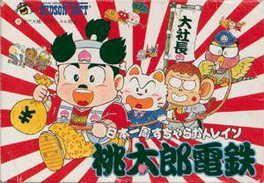
The first in Hudson's series of train-themed video board games which was released on the Famicom in Japan only on December 2nd 1988. Momotaro Dentetsu ("Momotaro's Railway") is a train-themed board game featuring the folklore hero of Momotaro, the Peach Boy. It is the first in Hudson's long-running series of the same name. The goal is for each player to drive a train around a board by rolling a die and trying to make as much money as possible, a la board games like Monopoly or the Game of Life. The game and its series is not to be confused with Momotaro Densetsu, an earlier RPG from Hudson featuring the same characters.The Money Game
1988
The Money Game
1988
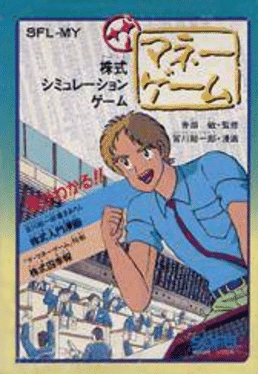
A Stock Market/life-sim game where the player must manage their stocks in order to achieve a happy life. It was developed by SOFEL for the NES and released in Japan only. The Money Game is a stock market simulation game where the goal is to raise money through the wise purchasing and selling of various types of stock. Coupled to this is a life-sim aspect where raising a sufficient amount of money at certain checkpoints allows the player to gain and keep a girlfriend, who later becomes their wife and provides children. As well, the player can upgrade from their initial studio apartment to a terraced house to a mansion with its own Olympic-sized swimming pool. The game is densely packed with Japanese script and requires both literacy in that language and a fairly good understanding of dealing in the stock market itself (though the game does provide tutorials for the latter). It would be followed by a sequel, The Money Game 2: Kabutochou no Kiseki, which in turn would be the basis for SOFEL's Wall Street Kid.Family Mahjong
1987
Family Mahjong
1987
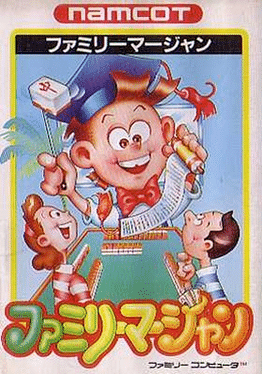
A mahjong game by Nihon Bussan and published by Namco for the Famicom. Family Mahjong is another in a long line of mahjong games for the Famicom. Uniquely, at least for the time, it does include a full tutorial mode that will teach the player how to actually play mahjong. It also includes rules for mahjong gambling, which is another feature included in the game. After the player has learned how to play, they can compete against a series of CPU opponents in one-on-one matches, most of whom are attractive blonde women for whatever reason.Family Mahjong II: Shanghai he no Michi
1988
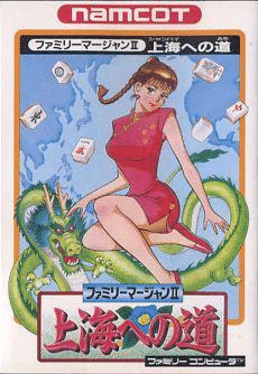
Family Mahjong II: Shanghai e no Michi is a Mahjong game released only in Japan for the Nintendo Famicom. Family Mahjong II: Shanghai e no Michi is a Mahjong game and the direct sequel to Family Mahjong. In addition to the standard Mahjong mode, there is a tournament mode with a slight RPG aspect to it, in that the player can enhance certain stats after winning games in order to increase their odds in future rounds of the tournament. The game is a one-on-one version of the game, less common in real-life Mahjong games but the standard for computer adaptations due to the reduced complexity of having only a single AI opponent. Nihon Bussan was responsible for Family Mahjong II's development and was at the time fairly well known for their Mahjong Arcade games.Family School
1987
Family School
1987
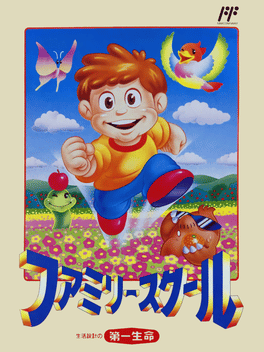
Family School is an action transport puzzle game, where your task is to water plants in some kind of garden so that fruit grows. Once the fruit has grown, you have to push the right fruit into the right basket at the edge of the playing field. Watch out for animals which will try to harm you. The game can be played with at least two players simultaneously. The game was apparently given as a free gift by 第一生命 (Dai-ichi life), an insurance company, to people who purchased policies from them.Family Trainer: Jogging Race
1987
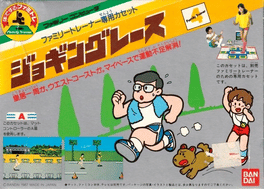
An exercise game created for the Family Trainer (the Japanese name for the NES Power Pad) developed by Human and published by Bandai. Jogging Race is the fourth game created by Bandai for the Family Trainer (US: Power Pad) accessory for Famicom systems. It was one of the many games that used the peripheral that did not see a release outside of Japan. As with other Family Trainer games, the emphasis was on receiving a work out using the Famicom, a conceit that would later find greater success with the Nintendo Wii and the Wii Fit games. Specifically, Jogging Race is about jogging through areas of a simulated Tokyo using the pad to simulate the exercise. The background scrolls by slowly, accurately matching the scale of the distances found in the real location, and will occasionally include additional details like other joggers. There is also a second mode named Marathon, in which the player competes in a long distance race with other CPU runners.Family Trainer: Meiro Daisakusen
1987
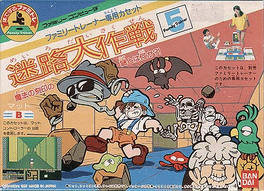
A Famicom game developed by Bandai as part of their Family Trainer series, which all use the Family Trainer (Power Pad) accessory. The goal is to explore mazes. The fifth in Bandai's series of Family Trainer games, created for the accessory with the same name (or Power Pad in the US). Unlike the others, which tended to be athletics/exercise games, Meiro Daisakusen ("Epic Maze Battle") is a maze-exploring light RPG where the goal is to walk and jump around mazes to find items and, eventually, the exit. The game's controls are dictated entirely by the Family Trainer/Power Pad. Different buttons will either cause the protagonist to jump, walk forward, walk backwards, turn left or right or switch their position to the left, right or center of the screen. While searching for the exit, players must be mindful of the various enemies that also inhabit the mazes, most of which must be avoided by jumping over them or running past them.Family Trainer: Rai-rai Kyonshis - Baby Kyonshi no Amida Daibouken
1989
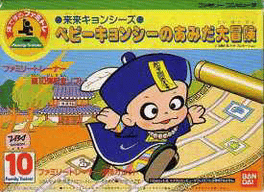
The tenth and final Bandai game to use the Family Trainer/Power Pad accesssory for the NES. The player helps a baby kyonshi (jiang shi) find its parents. Family Trainer: Rairai Kyonshizu is the final game in Bandai's series of Family Trainer games, intended for use with the peripheral of the same name (called the Power Pad overseas). It is based on a TV show about a young Kyonshi - better known as the Jiang Shi Chinese hopping vampire outside of Japan. The player, as the Kyonshi, must complete various mini-game challenges in order to help it reach its parents. The subtitle for this game is "Baby Kyonshii no Amida Daibouken" or "Baby Kyonshi's Ladder Adventure" - the ladder randomly determines the next mini-game.Hissatsu Dojo Yaburi
1989
Hissatsu Dojo Yaburi
1989
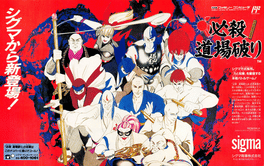
An RPG/Fighter hybrid developed and published by Sigma for the Famicom. It was never released outside of Japan. Hissatsu Dojo Yaburi is an RPG where players fight opponents in Yie Ar Kung-Fu style martial arts battles. The player needs to train for tournaments by encountering and defeating various foes, gaining XP all the while. When strong enough, they can fight a group of enemies one after the other in the tournaments that take place in towns. The player can also walk around towns interacting with friendly NPCs. This was Sigma Ent Inc.'s first Famicom game: Previously, they had only worked on Arcade games.Hissatsu Shigoto Nin
1990
Hissatsu Shigoto Nin
1990
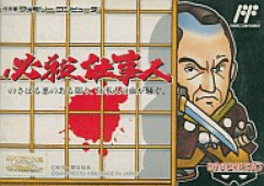
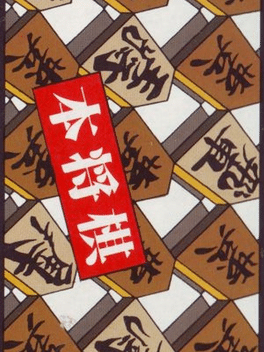
Hissatsu Shigotonin (Translated: Deadly Work People] was released December 15, 1990 exclusively in Japan for the NES. It is an RPG based off of the popular historical drama TV show of the same name. The Story focuses on a group of ordinary work people who have double lives as assassins.Hon Shogi: Naitou Kudan Shogi Hiden
1985
A video game biased off of the board game Shogi (Japanese Chess). It was developed and published by SETA Corporation to be released August 10, 1985, exclusively in Japan for the Nintendo Entertainment System. The game is named for Naito Kunio Kudan, a famous Shoji player from Japan. Born November 15, 1939, Naito has been a professional Shoji player since he was 18 years old. In addition to helping with this video game, Naito Kudan is a published author, having 13 books written about Shoji and running a column in the sports section of the newspaper. He is also a published singer but mostly does it as a hobby. In 2010 Naito was honored with the Order of the Rising Sun, twin Mitsuaki, the fifth highest honor a citizen can receive in Japan. Honshogi: Naitou Kudan Shogi Hiden, follows the standard rules of Shoji (Japanese Chess). There is no ability to change the difficulty or handicap. Most of the screen is the Shoji board, but there is also a representation of the player and computer playing Shoji in a Japanese settHyokkori Hyoutan-jima: Nazo no Kaizokusen
1992
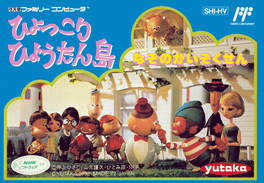
Hyokkori Hyoutan-jima: Nazo no Kaizokusen is an Action game, published by Yutaka, which was released in Japan in 1992.Ide Yousuke Meijin no Jissen Mahjong
1987
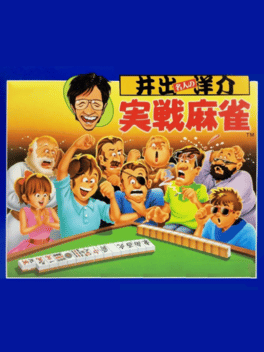
A Famicom-only Mahjong game that teaches a specific variant called "Attack Mahjong" and one of many Mahjong games presented by expert Ide Yosuke. It also had its own special Mahjong controller. One of a series of Mahjong games presented by Ide Yosuke (sort of the Dr Kawashima of early Mahjong titles), Ide Yosuke Meijin no Jissen Mahjong (or "Ide Yosuke: Master of Attack Mahjong") is a Mahjong game that teaches a very specific gameplay variant. Ide Yosuke Meijin no Jissen Mahjong also came with its own special Mahjong controller that resembles a keyboard. The game is unplayable without it.Ide Yousuke Meijin no Jissen Mahjong II
1991
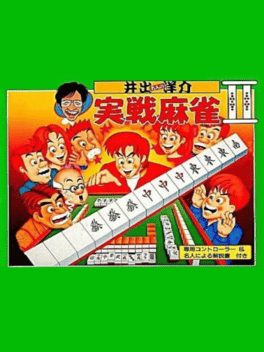
Ide Yousuke Meijin no Jissen Mahjong II is a Miscellaneous game, developed by Arc System Works and published by Capcom, which was released in Japan in 1991.