Most Popular Ps3 Games - Page 435

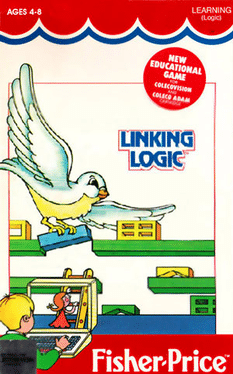
Linking Logic
1984
Linking Logic
1984
LINKING LOGIC challenges children to improve their logical reasoning and pluming skills. These skills play a key role in developing a child's ability to approach and solve problems. A child learns to identify different ways to approach a problem. plan actions to be taken. and evaluate the outcome of a solution. In LINKING LOGIC, your child places -tools- along a path to guide Ruddy or Betty down through five floors of a building. Along the way, your child helps the character collect the patterned tiles that are missing from the bottom floor.Memory Manor
1984
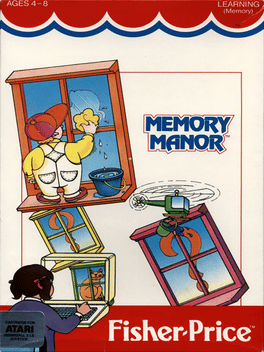
Memory Manor
1984
Wee Willie is a window washer at an apartment who wants to keep his customers happy. Some of the customers welcome him and want their windows washed while others are worrisome about his wet work and would not want him washing their windows. There's only so much water for Willie to wield in his bucket, so he must only waste it on the welcoming window wash customers. It's also raining so Willie will have to remember who lives where. Memory Manor is a memory matching game played from a side-view perspective. Players take control of Wee Willie who can move left and right, climb ladders and choose to wash a window he is in front of. The game relies on memory, after a brief glimpse of the people in the manor the windows fog up, hiding the occupants. The player must remember which windows contain happy customers and wash their windows. Willie has a limited water supply and so must not waste washing on anyone who doesn't want their windows washed. The game is over if Willie uses up all of his water.Fraction Fever
1983
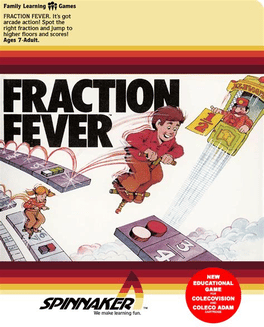
Fraction Fever
1983
In Fraction Fever, the player's goal is to advance floors up to the twentieth with the help of his pogo stick and the Fraction Elevators located on each floor. To find them, the player needs to look for the correct fraction pictures, matching what is shown at the top of the screen, while a radar shows the layout of floors at the bottom. Incorrect fractions can be knocked down for scoring points, but this leaves holes in the floors. When the player doesn't manage to jump over these and falls down far enough or several times, the game will end. There is also a time limit to look out for, if the clock reaches zero the Fraction Elevator of the current floor cannot be reached, and the player has to jump down a floor to be able to try again.Dinolympics
1993
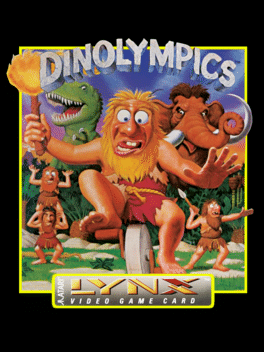
Dinolympics
1993
Come back to the dawn of history in this combination of puzzling problems, awesome adventures, and mind-bending mazes. The survival of your race is at stake!Breakout 2000
1997
Breakout 2000
1997
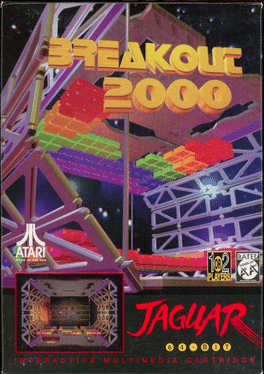
SMASH! POW! CRUNCH! Is your hand/eye coordination up to demolishing field after field of bricks? Breakout 2000 brings back the nostalgia of early gaming days but adds 90's challenges, such as a three-dimensional field and bricks that resist breaking, as well as many powerups and hazards. You can also test your skill against a buddy. Break through your own wall and start working on his. You'll gain bonus points, and he'll go nuts! Who ever said life was fair never played Breakout 2000.Mine Sweeper
Have you ever wanted to play the Windows time waster on your old Atari 2600? Well now you can!Pressure Gauge
2000
Pressure Gauge
2000
Pressure Gauge is a game that was written back in 2000 as a college exercise by John K. Harvey. It's not much to look at graphically, but this game is a "twitch" game that just may have you reaching for the reset button for "just one more round". The game was inspired by a mini-game in the Playstation title "Brave Fencer Musashi". Gameplay is simple. The initial screen says "Pressure Gauge"; from here, you can hit select to see the first homebrew attempt at a scrolling text demo (which would later be reformulated and released as StickyNotes), or you can hit the reset button to start the game. A little song will play, and you're on your way! The interface is as simple as can be-- it only uses the button. Push the button precisely when the leftmost "filling gauge" is lined up with the "range" on the left of it. Get within range, and you'll be rewarded-- slightly. The second gauge will fill up, just a little bit. You need to have a certain amount of successes in order to fill the second gauge all the way to the top, tRubik's Cube 3-D
1982
Rubik's Cube 3-D
1982
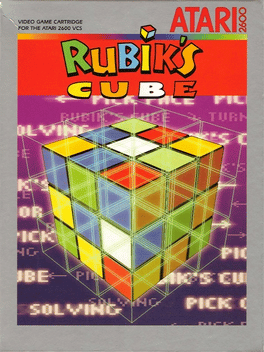
Can you solve it? Are you up to the challenge of trying to master the Cube? Restore all of its six sides to the original colors in this mesmerizing 3D translation of the hit puzzle game synonymous with the 80's! When solved, every face of Rubik's Cube is a solid color. Once you start turning, twisting and flipping, it's easy to mix up the colors. Not to worry - Rubik's Cube can be set right any mixed-up combination.Tetris26
1998
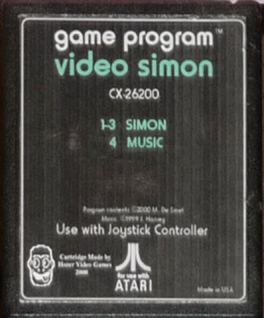
Video Simon
2000
Video Life
1981
Video Life
1981
Video Life is a rare video game for the Atari 2600. It is a version of the zero-player cellular automaton known as Conway's Game of Life. Video Life was only available through a special mail order offer to owners of CommaVid's Magicard, which itself is considered to be one of the rarest Atari 2600 cartridges ever released. According to original CommaVid co-owner Irwin Gaines, only 20 cartridges or less of Video Life were ever made. Editors of AtariAge estimate approximately 500 cartridges were produced. A report in the Chicago Reader by Jeffrey Felshman estimates that cartridges would sell for as much $3000 at the time.Dice Puzzle
1983
Dice Puzzle
1983
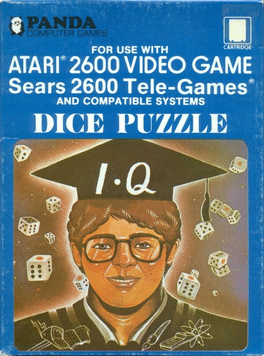
If you enjoy games like Rubik's Cube, then you'll like this one. The object of Dice Puzzle is to get all 16 dice to show the same number. You accomplish this by clicking on a column or row, which advances all of the numbers in that column or row by one (of course six advances to one). See how quickly (or in how many moves) you can do it.Eli's Ladder
1982
Eli's Ladder
1982
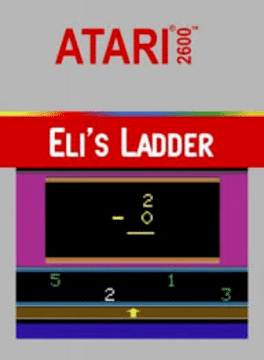
Eli's Ladder is an educational game aimed at children, where math problems need to be solved to help Eli and his crew climb a ladder to his space ship so they can then journey to the Moon. The game included a wall chart and stickers designed to help motivate children progress through the problems. This is one of the rarest Atari 2600 games and apparently saw fairly limited distribution.Berenstain Bears
1983
Berenstain Bears
1983
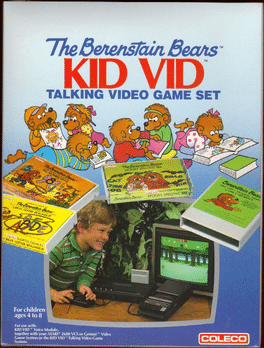
Berenstain Bears comes with three different cassette tapes that are designed to be used with the Kid Vid Controller (originally packaged with Smurfs Save the Day - the only other Kid Vid game). The cartridge won't do much without the tapes. At the beginning of each game, Actual Factual Bear takes off while you control Brother Bear on his unicycle. Avoid the boulders and cross the bridge to reach one of the games, chosen by the particular tape you are listening to. The games are: Big Number Hunt: Catch the correct numbers as they fall from the tree Great Letter Roundup: Catch the correct letters as they fall from the tree Spooky Spelling Bee: Spell a word by catching the letters falling from the treeCodebreaker
1978
Codebreaker
1978
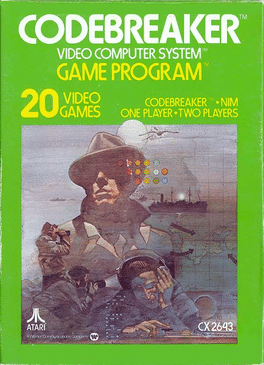
This one's not for stupid people. The goal of codebreaker is to guess a 3 or 4 digit number in 12 tries. The computer lets you know when your on the right track with some vague clues. In the second game, NIM, you and your opponent strategically remove blocks in an attempt to be the one to remove the last block.Toyshop Trouble
2007
Toyshop Trouble
2007
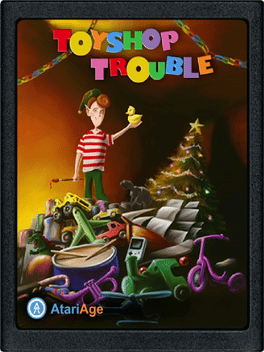
Ah, the Bahamas. Toyshop elves Patrick, Quincy, and Robert are laying on the beach, relaxing in the sun. Nothing could be finer than listening to the surf while enjoying a cold drink. A great reward for having gotten all of Santa's toys painted in record time. Unfortunately for you, Patrick's idea of "painting" toys was dumping them all in a bucket of gray paint. While this technically fulfilled his associates' obligations (thus their trip to the Bahamas), the toys--alas--still have to be painted properly. It's now your job to clean up their mess, which means properly painting the toys in time for Santa's departure Christmas Eve. You must paint the toys as they move along five conveyor belts. Ahh, but only if it were as easy as it sounds! Toys must be painted the proper color, and some toys require two coats of paint (with different colors), and if that wasn't bad enough, some must have their coats applied in the proper order! And not that you needed the additional pressure, but you also have a daily quota to meetPalamedes
1990
Vs. Dr. Mario
1990
Vs. Dr. Mario
1990
Vs. Dr. Mario is the Vs. System version of Dr. Mario. The game drops the Slow mode and features a less generous scoring system. In the NES version, each virus is worth twice as much as the last. In the VS. version, a virus is worth only 200 points more, and not twice as many points, as the previous virus.Twin Qix
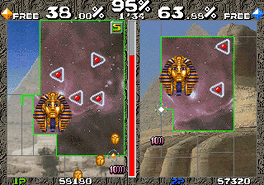
1995
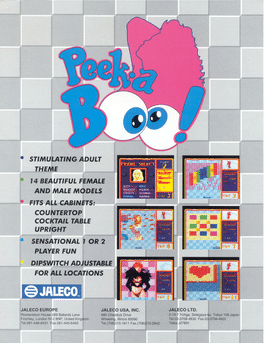
Peek-a-Boo!
1993
Peek-a-Boo!
1993
Move a paddle left and right to prevent a bouncing ball from escaping the screen at the botton. Use the ball to remove a pattern of bricks. Once all bricks are gone you get a reward and advance a level.