New Arcade Games - Page 103

Bikkuri Card
1987
Mutant Night
1987
Mutant Night
1987
Mutant Night is a shoot'em up game of the "run & gun" type : the players controls a walking character shooting at enemies while avoiding their attacks.[4] Unlike most run&gun games, Mutant Night has almost no platform part and the character's shooting power is very limited : short range and not multi-directional, the bubble are always shot in the direction the character is facing. The game is divided in various levels or acts and focuses on fast-paced action and memorization. The levels are very short and straightforward, with a level design relying only on enemies attack patterns and on the game's physics to challenge the player. Mutron-kun can walk left or right, shoot bubbles and jump, and hurries to reach a small trapdoor at the end of each level. The difficulty curve of the game increases significantly after the first level and can be somewhat unforgiving. Power ups are available in the form of small pink pods on the ground which when shot release a coloured orb into the air, which can do one of the followinAPB
1987
APB
1987
star 5.7APB ("All Points Bulletin") is a 1987 arcade game where the player assumes the role of "Officer Bob," a rookie police officer. As Bob, players drive around the city, ticketing motorists for minor infractions and pulling over more serious offenders. Eventually, players must apprehend criminals for which an all-points bulletin has been called.Darius
1987
Darius
1987
star 5.4Darius is a two-dimensional horizontally scrolling shoot 'em up set in a fictional future. Uniquely among shoot 'em ups, the game's screen is three times wider than conventional size, and the arcade cabinet uses an arrangement of three screens to accommodate it. The player controls an ornate fighter spacecraft, named the Silver Hawk, and must navigate through scrolling terrain while battling a variety of fighter craft, ground vehicles, turrets, and other obstacles throughout the game's stages (referred to as zones in the game). The ship's arsenal consists of forward-firing missiles, aerial bombs and a protective force field, all of which can be upgraded by power-ups (in the form of large, colored orbs) that are dropped by specially-colored enemies throughout the game's zones. When the player reaches the end of a zone, a boss appears, which must be defeated to proceed. Once the boss of a zone is destroyed, the player is given a choice of which zone to play next via a branching path. While there are 28 zones in totalSpy Hunter II
1987
Spy Hunter II
1987
The arcade sequel to Spy Hunter. It appeared in arcades and is simultaneously playable by two players.Combat Hawk
1987
Combat Hawk
1987
A reaction-based shoot-em-up in which the player takes on the role of an army soldier.Center Court
1987
Ark Area
1987
City Bomber
1987
City Bomber
1987
In City Bomber, the player is in pursuit of a gang of criminals. In order to keep the criminals from escaping, the player must reach checkpoints within a specified amount of time. At the start of the game, the player's car can shoot missiles at enemy vehicles and is also able to jump over enemies or obstacles. When some enemy cars are destroyed, power-ups are released that augment the car's abilities. Missiles improve the destructive power of the car's weaponry, wings extend the car's jumping distance, rocket boosters speed up the car and buzzsaws allow the car to ram obstacles without damage for a short time. Collisions with other cars are not generally harmful to the player, although they may slow down the car. Oil slicks dropped by enemies will spin out the car and slow it down significantly. Collisions with obstacles or falling off the course will destroy the player's car. While the player has an unlimited supply of cars, crashes will cost the player time and the new car will lose all previously-collected poweBlack Dragon
1987
Black Dragon
1987
In the history, there was a 3 dragons came from the sky with lightning to destroyed a kingdom. After suffered the darkness for a long time, a new hero was burn to conquest the dragons.Nekketsu Koukou Dodgeball-bu
1987
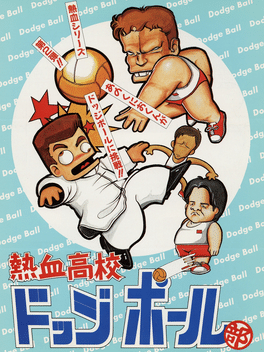
The original Japanese arcade version of the game which would be later be recognized as Super Dodge Ball.Kyuukyoku Tiger
1987
Kyuukyoku Tiger
1987
The original Japanese version of Twin Cobra, a 1987 Shooting Game developed by TOAPLAN. Kyukyoku Tiger has a swathe of differences to it's overseas counterpart, most notably reverting the player to a previous checkpoint on death rather than respawning them, and being one-player only. There are also more minor changes in factors such as the amount of shots the player can have on screen at once. The game was a success for Toaplan in arcades, reportedly reaching 10 Million worldwide players, and a number of console ports were made in the 90s. A sequel, Kyukyoku Tiger II/Twin Cobra II, followed in 1995, though this was developed by Takumi Corporation following TOAPLAN's bankruptcy in 1994.Quester
1987
Quester
1987
As with many other ball-and-paddle games (including Namco's own Gee Bee trilogy), the player must take control of a paddle at the bottom of the screen, and move it left and right to deflect a ball into the formation of bricks above it (and if you can keep that ball in play for a preset period of time, it will split into three balls) - certain bricks will also leave powerups when destroyed that will increase the size of the paddle, generate several extra balls in force-field when the initial ball goes into it and even create a line below the paddle that will prevent the balls from going out of play when collected. The seventh, fourteenth, twenty-first and twenty-eighth rounds are also "bonus rounds", where you have to destroy all the bricks in the formation within a preset time limit (unless all your balls go out of play); the thirty-third and final round is also a "boss round", where you are up against "Burida" (who is protected by a metal wall with a vulnerable spot on its top side, but does not attack by spittingThundercade
1987
Thundercade
1987
A nuclear powerplant has fallen into the hands of terrorists and you pilot a motorcyle equipped with machine guns that can be improved along the way. Make your way through difficult terrain and battle against loads of terrorists on foot, in cars, tanks and submarines who will try to stop you. Reach the plant and shoot all the terrorists to save the day.Blades of Steel
1987
Blades of Steel
1987
star 8.1From the opening Face-Off it's six on six pro-style hockey at its best. Their are eight teams for you to captain: Los Angeles, New York, Vancouver, Montreal, Edmonton, Minnesota, Toronto and Chicago. You can challenge a friend, or take on a multi-talented computer squad. You can also choose from three difficulty levels - Junior, College and Pro. Throughout the game, you'll constantly be tested by every intense element of championship hockey, from Penalty and Overtime Scenes to Knockout Smash-Hit Fight Scenes. Speed, strength, quickness and instinct are talents you must possess if you plan to prevail, especially when the anger flares, gloves come off and fists start flying. It's hard hitting action at its toughest. And you'll soon learn that in this league nothing's ever given to you, and before you can reach your goals - you have to score them. You've gotta master the artful skill of a finesse player and the bone crushing brutality of an enforcer. You'd better be versatile as well, because you must skillfully contAfter Burner II
1987
After Burner II
1987
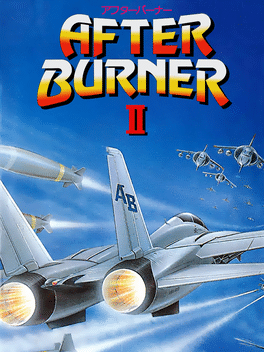
star 6After Burner II is an arcade-style flight game released by Sega in 1987. It is the second game in the After Burner series. In the game, players fly a F-14 Tomcat jet fighter, gunning down enemies while avoiding incoming fire. Like OutRun, another Sega arcade game, After Burner II came in several versions, the most famous being a large, servo actuated, sit-down cabinet which resembled a cockpit and moved according to the motion of the plane onscreen. The cockpit would bank in the same direction the on-screen aircraft was banking. There was also a more basic upright cabinet version.Airwolf
1987
Psycho-Nics Oscar
1987
Psycho-Nics Oscar
1987
Psycho-Nics Oscar is a 1987 side-scrolling run and gun arcade video game developed and published by Data East in Japan and North America. Set in the futuristic Ordio City, players assume the role of the titular mecha to fight against enemy invaders. Headed by Akira Sakuma, the title was developed by most of the same team that would later work on several projects at Data East. It received positive reception since its release from critics and has been cited as an influence for Turrican. The rights to the title are currently owned by G-Mode.After Burner
1987
After Burner
1987
star 6.2Muster up all the skill, reflexes and guts you've got. Because inside your F-14 Thunder Cat, you're going to need all that - and more. Blast laser-directed, anti-aircraft fire at enemy planes. Dodge heat-seeking missiles with fancy flywork, like dips, turns and barrel rolls. Come head to head with the infamous Flying Fortresses (the toughest of all enemies) and dogfight your way through, to a nanosecond of safety. And if you make it far enough, a fuel tanker will be waiting for you. Dock successfully and you'll replenish valuable energy and ammunition. So get your adrenaline pumping and grab your joystick. Then take to the skies. You're not going to believe what's up there!Blazer
1987
Blazer
1987
The player must alternate between a tank named "Vanguard" and a helicopter named "Maiheriko" (and for the tenth and final mission, a boat named "Maiboto"), to kill enemies both on land and in the air. Some air-based enemies will leave behind powerups for Vanguard to collect, when hit by its anti-aircraft missiles; they can restore its fuel, increase its fuel capacity, make it invulnerable for a short period of time, and even grant it an extra life if it manages to collect enough of them (which is initially thirteen, but it can go up to sixteen).