Most Popular Arcade Games - Page 139

Dungeon Magic
1994
Dungeon Magic
1994
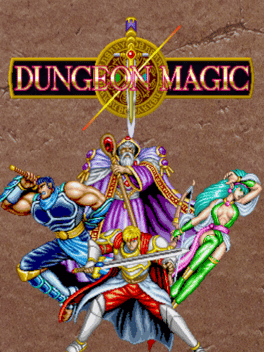
The evil magician has brought an evil spirit back to life and is plotting to seize control of the kingdom, and has kidnapped the princess for use as a sacrifice. Four warriors venture into the world of magic to save the princess of the kingdom from the wicked magician: Ash the knight, Gren the roving warrior, Cisty the elf, who whole family was destroyed by the evil spirit in the past, and the old magician Vold with the magic staff must now set off to save the princess.Galaxy Ranger
1983
Galaxy Ranger
1983
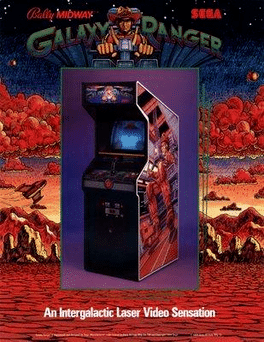
Interactive Laser Disc space battle game with computer-generated overlaid graphics. Control a space craft to defend against attacking enemy waves then destroy the enemy command ship. Huge explosions. Video images are from a Toei film - Message From Space.Golden Tee Classic
2001
1000 Miglia: Great 1000 Miles Rally
1994
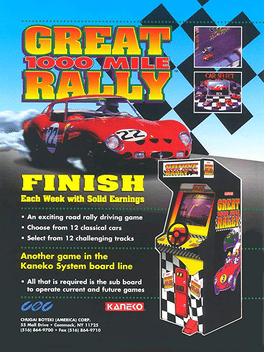
A driving game with top-down pseudo 3-D graphics. You can select one of ten cars and depending upon which vehicle has been chosen, you can select the starting point of the race. The game can be installed in a variety of cabinets using either a joystick and buttons or a steering wheel and foot pedals for control.Guardians of the 'Hood
1993
Three gangs have taken over your once peaceful neighborhood. Your job: break them up and convert their evil bosses to your side. Only then can you to regain your city and unmask the shocking identity of Mr. Big.Funky Jet
1992
Funky Jet
1992
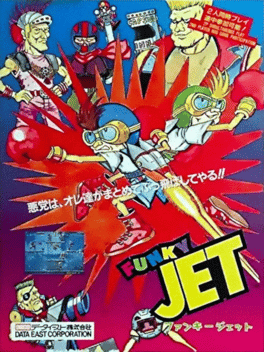
In the beat 'em-up game Funky Jet you control one of two characters equipped with a jetpack, a goggle pilot head and boxing gloves. There are six stages to choose from that increase in difficulty. The goal of the game is to clear the screen of all enemies that are standing on several platforms by flying around and hitting them with your gloves. Time bonuses and bonuses for clearing a stage are rewarded when clearing the screen. To complete a stage you have to clear several screens and defeat bosses and numerous smaller enemies. The game can be played solo or with a friend.Zarzon
1981
Zero Hour
1980
Zero Hour
1980
Zero Hour is a top view shooter where you control a spacecraft in multiple directions and try to blast and destroy three alien ships at the top of the screen. As you blast them, you will encounter meteors falling down the screen which can be avoided or shot, and other alien ships dropping bombs. If you hit a meteor, alien ship or its bombs then you lose one of three lives. Once the three aliens have been destroyed and the screen cleared of meteors and aliens then you move to a bonus screen. Your ship falls down the screen and you have to land on a landing pad for a bonus score. Two players can play and each player takes it in turns when the other player is killed.Lady Master of Kung Fu
1985
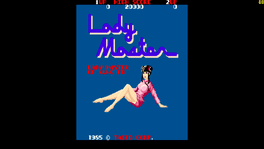
A sidescrolling action game by Taito, released to arcades in 1985. Unusual in that the player character was female.Crazy Cross
1994
Crazy Cross
1994
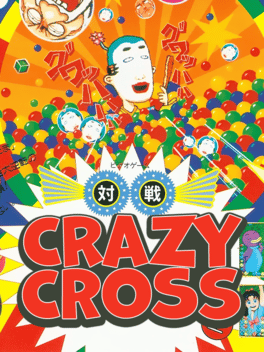
Taisen Puzzle-Dama is a puzzle video game and the first video game in the Taisen Puzzle-Dama series. It was released in July 1994 by Konami in Japanese arcades. It was released in Europe as Crazy Cross. The gameplay of the series is similar to other matching-based puzzle games, such as Puyo Puyo, being a battle game between one player and either a human or CPU opponentDingo
1983
Dingo
1983
Big Ted the koala is so fond of fruit that he has cultivated an enormous melon patch in the jungle. But unfortunately the patch has been invaded by a pack of evil dingoes that love nothing more than stomping on poor Ted's melons and creating a lot of havoc in the process. Big Ted has to harvest the fruit as fast as he can to save them from the invading marauders. Big Ted has to run around the melon field to collect all the fruit to advance to the next level. Meanwhile he has to avoid the nasty dingoes who will terminate him upon contact and take away one of his three lives. Ted can defend himself by picking up fruit to throw at the Dingoes to stun them for a few seconds, but the dingoes can also pick them up and throw back at him, which can prove fatal. Thrown fruit is wasted and thus can not be used as further projectiles or to increase the score.800 Fathoms
1981
800 Fathoms
1981
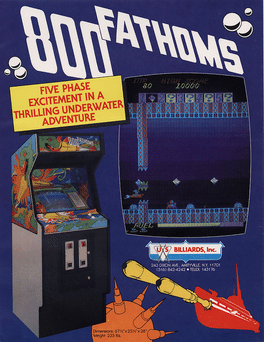
The player has to guide a submarine armed with torpedoes and missiles through five levels while fighting different underwater terrors. The game play is easy during the first five areas but it gets really tough at the later levels where the underwater landscape "grows" and there is not much space left for maneuvering the submarine. At the end of each area the boss-submarine appears and its firepower is not easy to overcome. US Billiards, the 800 Fathoms maker, released 10 different machines in our database under this trade name, starting in 1973. Other machines made by US Billiards during the time period 800 Fathoms was produced include Ab$cam, Variety, US Billiards, Video Pool, Survival, and Shark.Ace Driver
1994
Ace Driver
1994
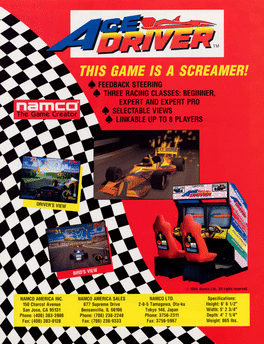
Ace Driver made extensive use of the CPU Assist technique whereby a trailing player would be given a significant speed boost to allow them to catch the leading player. However, the speed boost continued for a short while after the losing player had overtaken the leader - leading to a tactic known as boosting where a player would deliberately allow themselves to lose the lead, then during the last half of the last game lap would easily take back the lead with no hope of the opposing player catching them. Boosting also meant that straight skill races were difficult to have as CPU assist would be continually changing the losing players speed and position.WWF WrestleFest
1991
WWF WrestleFest
1991
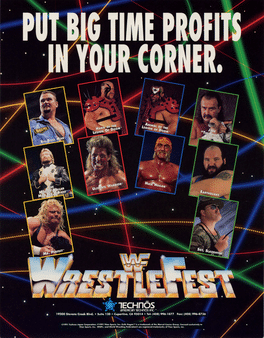
WWF WrestleFest is a professional wrestling arcade game released by Technos in 1991, featuring stars of the World Wrestling Federation. The game is the sequel to WWF Superstars. The game was distributed by Technos in Japan and North America and by Tecmo in Europe and Australasia.Vandyke
1990
Vanguard 2
1984
Vanguard 2
1984
Vanguard II was produced by SNK in 1984. SNK released 156 different machines in our database under this trade name, starting in 1979. Other machines made by SNK during the time period Vanguard II was produced include Gladiator 1984, Jumping Cross, Main Event, Mad Crasher, Alpha Mission, Joyful Road, Marvin's Maze, Lasso, Satan Of Saturn, and Sasuke Vs. Commander. Vanguard 2 defends the planet from an attacking alien space platform that is defended by enemy spacecraft. The Fire button handles air-to-air combat but it takes the Missile button to destroy the continually moving space platform below.'88 Games
1988
'88 Games
1988
Konami '88 (also known as '88 Games or Hyper Sports Special) is the third in the Track & Field game series by Konami, where you test your Olympic skills against other world-class athletes. As the name implies, it is loosely based on (and not licensed by) the 1988 Summer Olympics in Seoul, South Korea. Bronze or silver medals are not good enough - you have to go for the gold to get to the next event. However, you must at least qualify in each event in order to compete in the next event.Golden Tee 2K
2000
Golden Tee 2K
2000
Golden Tee Golf (also known as Golden Tee) is a golf arcade game series by Incredible Technologies.Air Inferno
1990
Air Inferno
1990
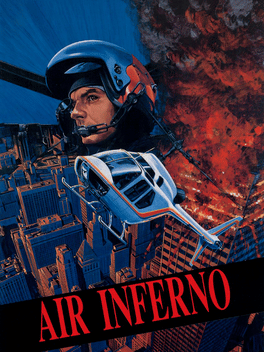
Air Inferno is a 1990 flight simulation video game published by Taito Corporation in North American territories.Apache 3
1988