Most Popular Arcade Games - Page 51

Rambo III
1989
Rambo III
1989
Rambo III for the arcade is a different game compared to the one released for the SEGA consoles and the computer ports. The arcade version was is a rail shooter game played from the third-person perspective whereby Rambo would have to blast through hordes of enemy soldiers, jets, tanks using various weapons with crosshairs, as well as fight tank bosses at the end of each level.Valve Limit R
2004
Quasar
1980
Quasar
1980
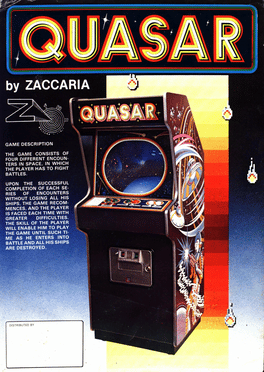
"The game consists of four different encounters in space, in which the player has to fight battles. Upon the successful completion of each series of encounters without losing all his ship, the game recommences, and the player is faced each time with greater difficulties. The skill of the player will enable him to play the game until such time as he enters into battle and all his ships are destroyed."HWY Chase
1980
HWY Chase
1980
A "Galaxian" type game. Shoot the flashing car (alien) on the screen the clear the level. HWY (pronounced Highway) Chase was released in December 1980 in the Japanese arcades. It was the very first video game made for this system (Cassette No. 01) along with Sengoku Ninja-tai (known as Ninja out of Japan) and Manhattan. It is said the title HWY Chase (HWY instead of Highway) was selected to easily recycle source code and materials made for 'Mad Rider', released earlier as a PCB, and known as 'Mad Alien' out of Japan.Mouja
1996
M.V.P.
1990
Snezhnaja Koroleva
1988
Snezhnaja Koroleva
1988
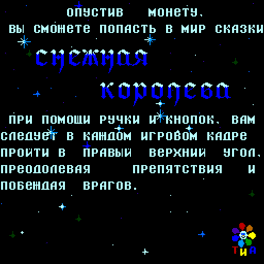
USSR maze game based on the 1967 Soviet film based on the 1844 fairy tale by Hans Christian Andersen.Legend
1986
Legend
1986
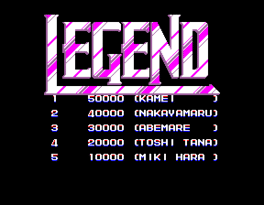
The player controls a young commander which uses a green armour and helmet and must defending the kingdom lands from invading enemies, following the orders and instructions given by the old king, for it you'll have to use money to making defect the enemy and recruit under your commands to form a legion of soldiers and make uses of different arms collected on the way, like bombs and arrows to defeat other enemies while you jump and dodges his attacks, always avoiding contact with any enemy for not to die and continue his legendary journey.Same! Same! Same!
1989
Same! Same! Same!
1989
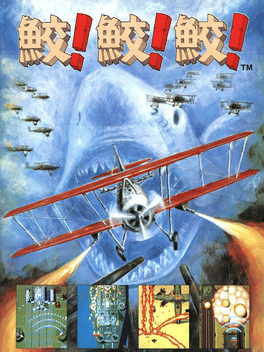
A shooting game developed and published by Toaplan, released in 1989. The Original Japanese version of what was released in the west as Fire Shark, 'Same! Same! Same!' is notable for being single-player only and having a dramatically heightened degree of difficulty compared to its western release, as well as lacking a number of glitches that came as a result of the conversion to a 2 player game.Initial D Arcade Stage 3
2004
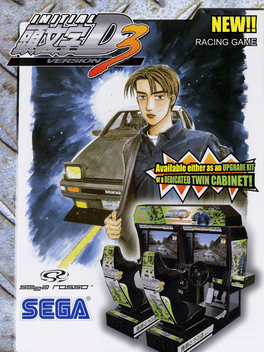
Initial D Arcade Stage Ver. 3, known internationally as Initial D Version 3, is a 2004 racing arcade game developed by Sega Rosso and published by Sega Corporation. It was developed for the Sega NAOMI 2 arcade system, marking the last in the series to be developed on the system, and was later ported to the PlayStation Portable in 2006 as Initial D Street Stage. It is the third game in the Initial D Arcade Stage series. Two new courses have been added: Shomaru Pass and Tsuchisaka, both of which were featured in Initial D Special Stage, as well as the option to race on Akina in the snow. Three new rivals have been added: Miki, Ichijo (known as Man in Evo VI) , and Aikawa (known as Man in Evo V). New cars featured in the game are the Mitsubishi Lancer Evolution V, Lancer Evolution VI T.M. Edition, Mazda RX-8, and the Nissan Skyline 25GT-T. The game features original Eurobeat songs from artists including Matt Land, Powerful T., Ace Warrior, and Marco Polo.Dacholer
1983
Saturn
1983
Super Dodge Ball
1987
Super Dodge Ball
1987
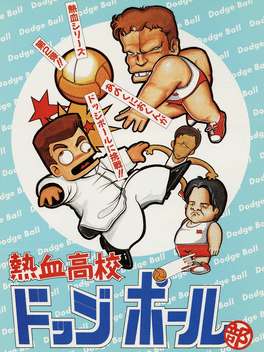
Super Dodge Ball is the localization for the Japanese Arcade game Nekketsu Koukou Dodgeball-bu.Nekketsu Koukou Dodgeball-bu
1987
The original Japanese arcade version of the game which would be later be recognized as Super Dodge Ball.Sokonuke Taisen Game
1995
Sokonuke Taisen Game
1995
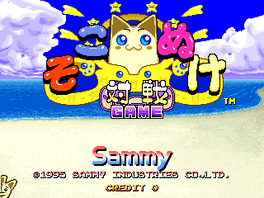
In this strange party game you must compete in simple yet strange events such as inflating balloons, morphing into dragons, etc., while at the same time protect your partner from 'harmless' pain inducers such as razor-sharp buzzsaws and bombs! Features nice graphics and hectic gameplay!Renegade
1986
Bonk's Adventure: Arcade Version
1994
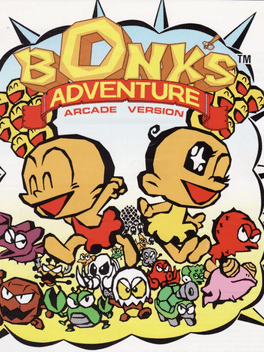
Developed by Kaneko and released in 1994, Bonk's Adventure: Arcade Version is based on the original Bonk games for the TurboGrafx-16 and PC Engine. However, the gameplay and level design are drastically different to suit arcade style play.Street Fighter III: 4rd Strike
2013
A Street Fighter III: 3rd Strike hack that rebalances and adds a lot of content.Chunithm Super Star Plus
2021
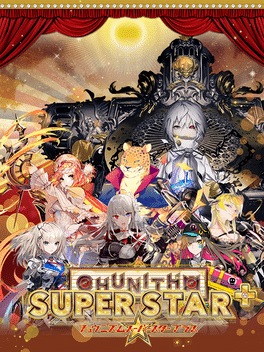
The append version of Chunithm Super Star Plus (Standalone Expansion). It has launched Sep 2, 2021 via Online Update. Added the new features: Course Mode, World's End.