New Games - Page 12449

Kodomo Chousadan Mighty Pockets: Chousa 3 - Kyakusen Queen Patra no Nazo
1998
The third and final episode (investigation) of Kodomo Chousadan Mighty Pockets. Kodomo Chousadan Mighty Pockets is a downloadable 3-part Soundlink game for the Satellaview that was broadcast in at least 2 runs between September 7, 1997 and March 28, 1998. The game plays like a board game with a detective motif similar to the game of Clue/Cluedo. The rules of the game however, are considerably different. Throughout the game, SoundLink narration is used; including rapping over Michael Jackson sound samples and remixes of 1950s American Television.Madojeongi: Secret of Elysium
1998
Madou Monogatari: Secret of Elysium is a first-person dungeon-crawler with minimal to no numerical statuses. The player navigates the maze-like floors of the towers by solving puzzles and defeating enemies. Madou Monogatari: Secret of Elysium was only released in Korea.Medarot Parts Collection
1998
Medarot Parts Collection is an add-on game for Medarot 1 released for the Game Boy in 1998. It's a side game where the player Robottles their way through a tower and collects parts, which can then be traded to the main game.Soldiers at War
1998
Soldiers at War
1998
Sequel to Wages of War, Soldiers at War is a squad-based tactical game. Lead a squad of American soldiers in WW2, performing covert operations against the Nazis. Soldiers at War is turn-based, squad-level combat with all the heroism and action of a good world war 2 movie! Lead a squad of 8 men through hair rising campaign of 18 linked scenarios. Experience D-day and the assault on Monte Cassino. Execute commando raids and fight fierce house-to-house battles in blasted cities like Anzio and Cherbourg. An extremely flexible mission editor and 10 extra standalone missions make the action virtually endless. 4 player multiplay via network or the internet lets you fight it out with real opponents!Makeruna! Makendou Z
1998
Real Bout Fatal Fury 2: The Newcomers
1998
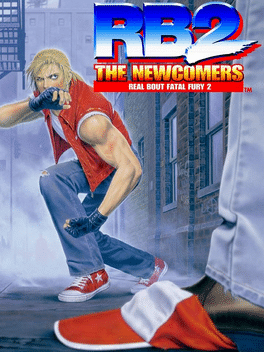
star 7.9Real Bout 2 revamps the two-line battle system from Real Bout Special. Instead of fighting in either two lines, the player is now forced to fight in a main line, while the second line is a "sway line" used to avoid attacks (similar to the original Real Bout). The one-line trap stages last seen in Fatal Fury Special also return.Burnout: Championship Drag Racing
1998
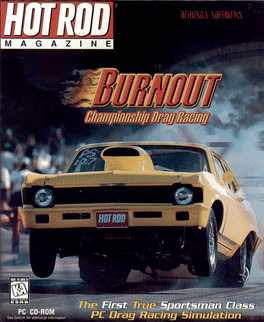
Burnout is a racing simulation devoted to the world of drag racing. You fine-tune your car in the hopes of then being able to send it at insanely high speeds in short, linear tracks. And this is what makes the bulk of the game, a dizzying array of customization options are available for you to construct the perfect hot-rod, essentially making it a "grease monkey" simulation. Additional features include bracket racing (where you select an estimated time based on your practice runs, and try to meet it against other cars), quick race and a complete season against 64 computer controlled cars. Also available is multiplayer racing through modem, LAN or internet. The graphics engine is a suped-up version of the X-Car engine, and supports 3D acceleration with all sorts of nifty effects such as smoke, sparks, tire distortion, etc.Final Fantasy V
1998
Final Fantasy V
1998
A port of Final Fantasy V for PlayStation that adds an opening and ending FMV cutscene as well as some gameplay improvements such as the ability to sprint. It is largely similar to the Super Famicom version but due to the CD-ROM format of PlayStation it has longer load times in comparison to the Super Famicom version. In Japan it was available as part of Final Fantasy Collection, while in North America and Europe it was available only as part of Final Fantasy Anthology. This is the first international release of Final Fantasy V as the Super Famicom version was only released in Japan.Frogger
1998
Track & Field
1998
Parodius
1998
Block Game
1998
Inferno
1998
Inferno
1998
Inferno (not to be confused with Doom's original third episode) is a nine-level episode replacement designed by Christopher Lutz and released in March 1998. The mapset is themed after Doom episode Inferno, replacing all levels with new ones designed around the Hell map visual style.SimSafari
1998
SimSafari
1998
SimSafari brings Africa to you. Imagine yourself in rugged bush country, peering through binoculars at vast herds of elephants, zebras and lions. Choose from exotic plants and wildlife to create your own safari park. Team with a neighboring village and build a flourishing safari camp. Even tackle wild missions! Subtle mix between SimCity and an African Safari. For ages 8+.Mitsumete Knight
1998
Mitsumete Knight
1998
Mitsumete Knight is a 1997 Dating Sim on PlayStation 1, developed by Konami in cooperation with Red Company. The spiritual successor of Konami's smash hit Tokimeki Memorial: Forever with you, it uses the same game engine and most of its successful mechanics, but with several exciting twists!Irritating Stick
1998
Irritating Stick
1998
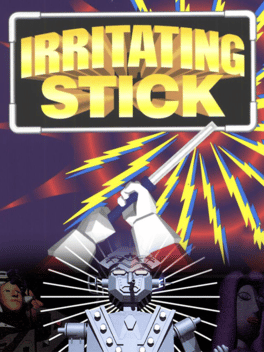
Irritating Stick (originally Dengeki Iraira Bou), is a carnival game in which the player has to move a spinning stick through maze-like levels, without touching the borders. If the borders are touched, the player gets zapped and loses the game.Princess Quest
1998
Princess Quest
1998
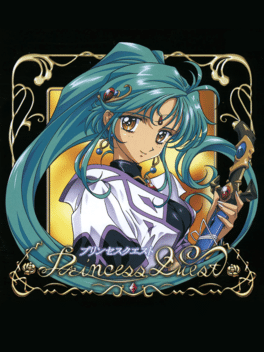
Princess Quest is a Japanese video game published in 1998 for the Sega Saturn system. It was subsequently ported to PC under the title Princess Quest R.Gunbare! Game Tengoku: The Game Paradise 2
1998
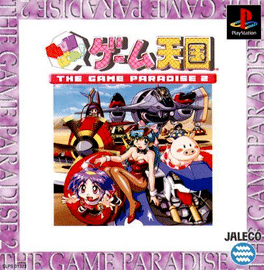
PlayStation-only sequel to Jaleco's crossover cute-'em-up. The system uses a gun controller connected to the 2P controller socket to provide cover fire for the shooter. The title of the game is therefore a combination of Gun and the Japanese word Ganbare (Don't give up!). Even if you don't have a gun controller, you can use a DualShock controller to shoot for cover.Downhill Bikers
1998
Downhill Bikers
1998
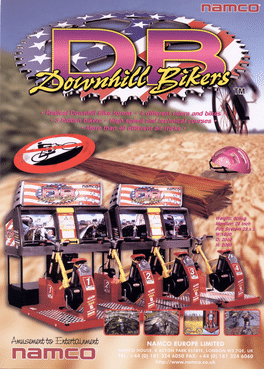
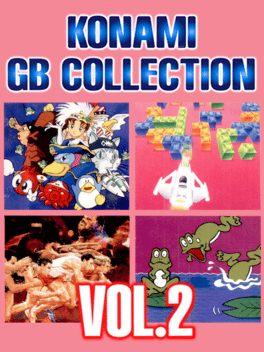
Downhill Bikers is an arcade bicycle racing game released by Namco in 1998. One to four players race downhill to compete for time, performing aerial stunts from mid-course jumps.Konami GB Collection Vol. 2
1998
The Konami GB Collection is a series of video game compilations for the Game Boy Color. The compilations were originally released from 1997 to 1998 in Japan for Game Boy, and were later released in Europe in 2000 for Game Boy Color. Included in Volume 2: - Parodius - Block Game (Quarth) - Track & Field - Frogger This was released as Volume 4 in Japan.