New Games - Page 13328

Crimson
1987
Crimson
1987
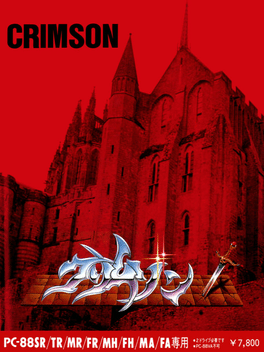
Crimson is a medieval-themed role-playing game similar to Dragon Quest. The player controls a lone character, a young man whose father sent him on a mission to defeat the evil monster Crimson before passing away. Exploration is done in an overhead fashion, and is divided into world map and hostile areas, which are usually maze-like and contain one or more dungeons each. In towns the hero can buy weapons, armor, and items, as well as rest in inns. Enemies appear randomly, and the battles are turn-based. The player character can either attack, defend, or use an item. Combat is viewed from a first-person perspective. Unlike Dragon Quest, there are no random encounters on the world map. Exploration is non-linear, i.e. the player has access to many areas of the map from the beginning of the game.BreakThru
1987
BreakThru
1987
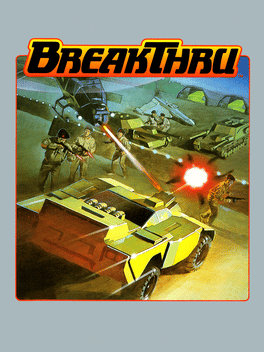
The NES port of BreakThru, a 2D side-scrolling vehicle shooter. Your mission: race, jump, and blast your way through five levels (mountains, bridge, plains, city, and airfield) of enemy defenses to recapture the stolen jet fighter. A host of enemy soldiers, mines, vehicles, and aircraft will try to stop you, though. Oh yeah... and don't forget to watch out for those rocket attacks and falling rocks!Nekketsu Koukou Dodgeball-bu
1987
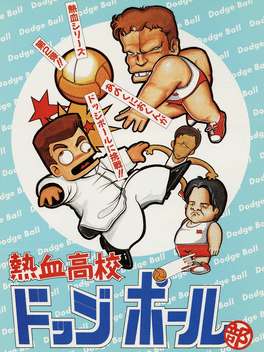
The original Japanese arcade version of the game which would be later be recognized as Super Dodge Ball.Palace of Magic
1987
Palace of Magic
1987
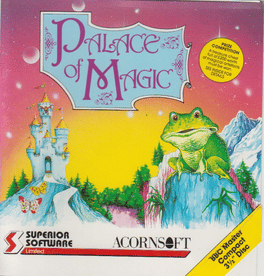
Palace of Magic is a platform game. Combining platform elements with problem solving, it similar gameplay to the earlier Citadel. Both are early examples of the Metroidvania genre.A1 Spirit: The Way to Formula-1
1987
A special version of the original F-1 Spirit, A1 Spirit: The Way To Formula-1, was released as a pack-in with Panasonic's "Joy Handle" game controller. The chief differences is that it features futuristic vehicles instead of racing cars, different passwords (e.g. "PANASONIC" to see the ending demo), and some bugfixes.Emi-chan no Moero Yakyuuken
1987
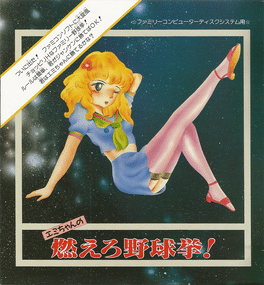
Moero Yakyuuken is basically strip rock paper scissors, there's not much more to the game except that Emi puts clothes back on when both of you choose the same option.Jinxster
1987
Jinxster
1987
Just when a man thinks his luck is running out, things start getting even worse. He gets run over by a bus. Sprayed with cheese sandwich by a supernatural being. Smashed against a tunnel by a speeding train. He gets incinerated, widdled on, folded, bent, spindled, mutilated and generally mucked about with. And in return? He gets the leading role in a perplexing, hilarious race against time and chance, set in a jinxed land menaced by the impending death of good fortune. Look on the bright side - it could be your luckiest move yet. Don't expect tiresome trolls, obvious orcs, silly spells and wet, wimpish witches in JINXTER. Infuriating, enchanting, absurd and hilarious by turns, JINXTER will surprise you with every move you make. But don't forget: every silver lining has a cloud.Chuck Yeager's Advanced Flight Trainer
1987
This early flight sim prominently features the voice and likeness of record-setting pilot Chuck Yeager. He offers helpful advice after the player crashes including "You really bought the farm on that one!"Operation Wolf
1987
Operation Wolf
1987
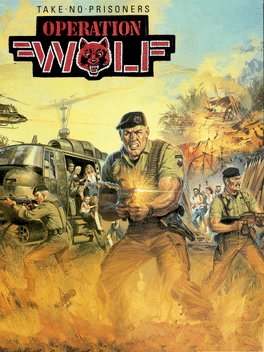
Arcade Commodore C64/128/MAX ZX Spectrum Atari ST/STE TurboGrafx-16/PC Engine DOS FM Towns Amiga Amstrad CPC MSXstar 6.5In the steamy jungles of South America, heavily armed extremists are holding innocent civilians prisoner. Little do these terrorists know that real terror is about to land on their front porch! The sound of rotor blades and staccato bursts of gunfire echo through the valleys. Terrorists be warned! Operation Wolf is going to teach you what terror is all about! Operation Wolf consists of six missions, which are displayed on the Operations Map Screen. A mission is completed when all enemy forces are reduced to zero. The current level is completed when you escape from the airport with the prisoners. Your injury level increases when the enemy hits you. The game automatically ends if the injury indicator on the right side of the screen becomes completely red. You can reduce your injury level by getting power drinks.Gotcha! The Sport!
1987
Gotcha! The Sport!
1987
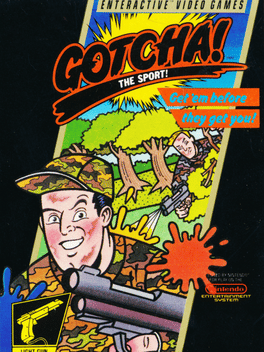
Gotcha! is an NES Zapper title based on the "sport" of paintball, and loosely tied into the paintball-themed movie caper of the same name. You are required to traverse three different battle zones, grab the opposing teams' flag from the opposite end of the field, and make it back to your flag without getting shot. One hand controls the Zapper while the other must hold the controller, since the D-Pad controls your movement up and down the field. Limited ammo is also a concern, as is the ability for the computer team to snag your flag and return it to their base to win. You can chase down and tag the flag carrier yourself to prevent this.Inigo Gets Out
1987
Side Pocket
1987
Side Pocket
1987
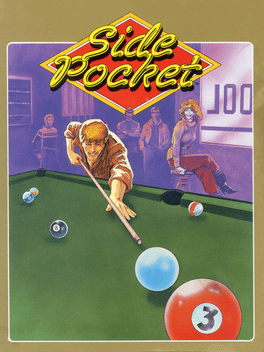
The NES port of Side Pocket, a pocket billiards video game originally released into arcades by Data East in 1986.Joust
1987
Joust
1987
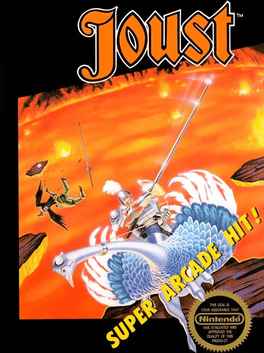
star 5.9The arcade classic was ported to Famicom and Nintendo Entertainment System by HAL Laboratory under the programming of legendary Satoru Iwata.Bubble Bobble
1987
Bubble Bobble
1987
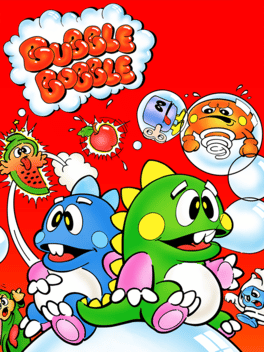
star 7.7Bubble Bobble is a platform game, with each level being a single screen. The enemies must be cleared from a level to go to the next one. With one player controlling Bub and the other controlling Bob, the player can jump and collect items for points (such as fruit). The real power Bub and Bob have however is the ability to blow bubbles. These bubbles can be as platforms to leap on, or to trap enemies. Enemies trapped in a bubble must be popped by jumping into them, wherein they'll turn to fruit. Additionally, power-ups sometimes float by in bubbles. They include lightning, which flies out horizontally at enemies, and water, which drags the player and enemies straight down flowing over platforms. Taking too long to complete any level will summon Baron Von Blubba, who will float around the screen trying to destroy the player.Bikkuriman World
1987
Bikkuriman World
1987
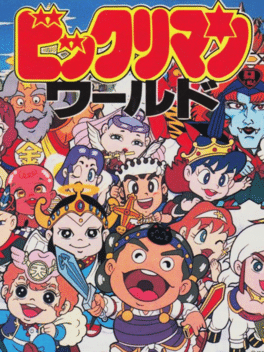
A version of the arcade game Wonder Boy in Monster Land by developer Westone. Unlike other ports of this game, this version was developed by Westone themselves, but re-themed to use the setting of the anime Bikkuriman, which started airing around the time of released. It is one of the two launch titles for the PC Engine.Famicom Grand Prix: F-1 Race
1987
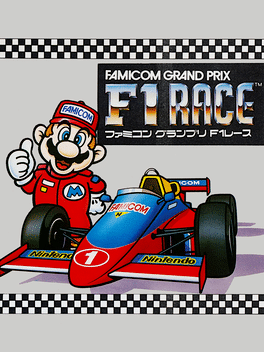
Famicom Grand Prix: F-1 Race is a Japan-exclusive racing game starring Mario in Formula One cars. In the game, players can choose to play alone or with other cars. Cars have a certain amount of health and fuel, which decreases whenever the player crashes into a wall or another car, as well as whenever he or she drives off of the road. This game, along with its sequel, was possibly an ancestor to the Mario Kart series, most likely due to the fact that it features Mario and possesses similar 2D racing mechanics, which was later carried on to Super Mario Kart.Karaoke Studio Senyou Cassette Vol. 1
1987
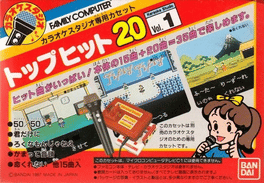
Karaoke Studio Senyou Cassette Top Hit 20 Vol. 1 is the first add-on for the Karaoke video game Karaoke Studio, featuring twenty additional songs. It cannot be played without the original cartridge and microphone peripheral. All the game modes themselves remain unchanged.Hoshi wo Miru Hito
1987
Hoshi wo Miru Hito
1987
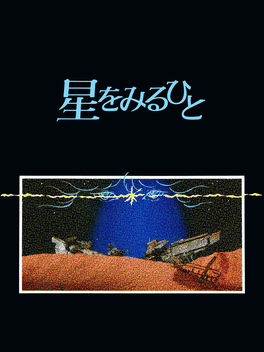
Hoshi wo Miru Hito is a role-playing video game produced and sold exclusively in Japan for the Family Computer in 1987. Published by HOT・B, it is based on their earlier 1984 cyberpunk-themed computer role-playing game Psychic City. The game is set in a decadent cyberpunk-style future world in which everyone has extrasensory perception. These powers can also be used by the player characters when they confront the various monsters in the game through combat. The eventual target of the game is to defeat the villains. In order to accomplish this, the player's characters must go to the Ark City and eventually to outer space. Unlike the Final Fantasy series, the game does not give the player an automatic "game over" when it is impossible to win the battle. This makes it possible for players to accidentally walk into a walking dead situation every time they are forced to do battle with the game's monsters.Peachboy Legend
1987
Peachboy Legend
1987
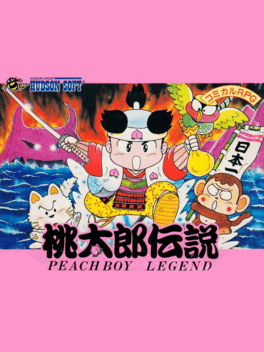
An RPG based on the popular Japanese folklore legend of Momotarou, the Peach Boy. This was the first in a series of Momotarou games by Hudson and was only released in Japan.