New Sega Game Gear Games - Page 77

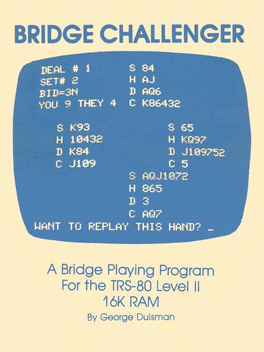
Bridge Challenger
1978
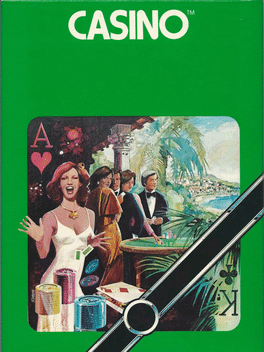
Casino
1978
Casino
1978
star 3.4Casino is a collection of three card games: Blackjack, Five-card stud poker, Poker Solitaire.Computer Othello
1978
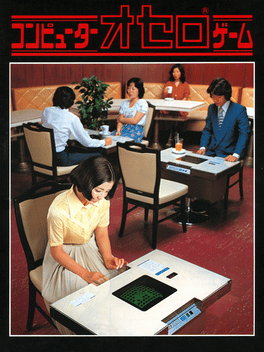
Computer Othello
1978
An arcade video game released in 1978 exclusively in Japan. It was the first video game both published and developed by Nintendo, and the first game developed by Nintendo R&D1. The game was a computerized version of the board game Othello (also known as Reversi). The game allowed for one person to play Othello against a computer opponent. It was also possible for two people to play head to head.Blackjack
1977
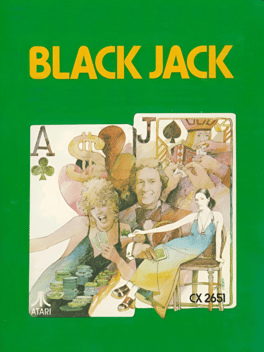
Blackjack
1977
star 3.4Atari's Blackjack employs a variant of blackjack rules that is so extremely unfavorable to the player, that it would almost certainly never be seen in a real casino because no one would play with them. Splitting pairs is not allowed, and even more substantially, draws are won by the dealer (your bet is not returned to you if you and the dealer get the same card total and neither busts). This represents over a 10% house advantage. The player uses the paddle controller to enter a bet of up to 25 chips from an initial pot of 200. An up card is then presented, and the player decides whether to "hit" (accept another card) or stand. The player breaks the bank by obtaining a score of 1,000 chips, or is "busted" upon losing everything. Due to a glitch in the program, while a player is selecting among the options of what to do with the current hand by pressing left or right with the paddle controller, the amount of the player's next bet is modified even though it is defined by a variable that will not be visible until theQubic
1968
Qubic
1968
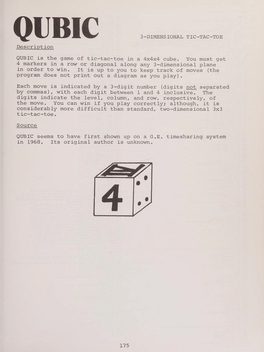
A text-based game of 3D Tic-Tac-Toe against a computer opponent. Originally, the game printed out the game board on teletype paper. It was later updated to include a visual display of the game board.Draughts
1952
Draughts
1952
A game of draughts (a.k.a. checkers) written for the Ferranti Mark 1 computer by Christopher Strachey at the University of Manchester between 1951 and 1952. In the summer of 1952, the program was able to "play a complete game of Draughts at a reasonable speed".Mate-in-Two
1951
Mate-in-Two
1951
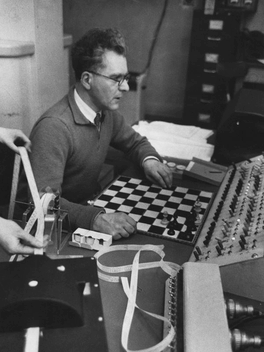
Robot Chess is an early chess game in which the user can play against an AI. The AI is only powerful enough to compute "mate-in-two" problems and thus the game didn't represent a full game of chess. Players would enter moves of the Ferranti Mark 1 and the computer would print out the response move. The simulation ignores some chess rules such as en passant, promotion and castling.