Most Popular Arcade Games - Page 114

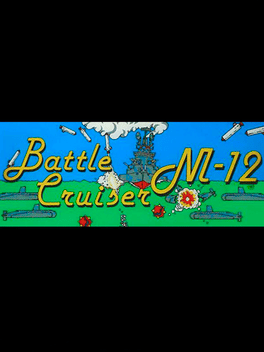
Battle Cruiser M-12
1983
Battle Cruiser M-12
1983
Battle Cruiser M-12 is a vertical shooter produced by Sigma Ent. Inc. in 1982.Kero Kero Keroppi no Issho ni Asobou
1993
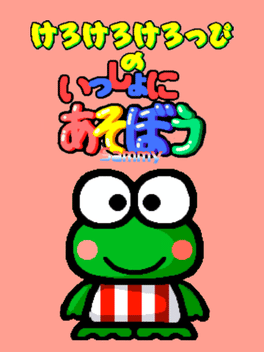
A one player misc. game published and developed by Sammy Industries in 1993. US version is called Kero Kero Keroppi's let's play together.Kid no Hore Hore Daisakusen
1987
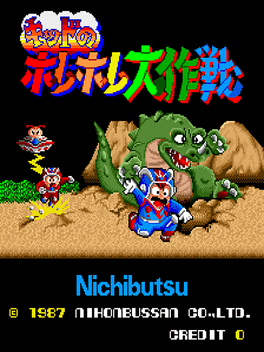
Before the SNES adaptation, Nichibitsu had actually licensed the Heiankyo Alien game in order to create its Kid no Hore Hore Daisakusen series. Although it features hole digging/enemy trapping mechanic, it's hardly the trap-'em-up that Heiankyo Alien is. The real goal of each level is to collect all the items available to exit the level through a door. With the use of other items such as flame throwers and bombs, you could play through the entire game without once trapping an enemy. The game had several sequels, including Booby Kids for the Famicom and Doraemon Meikyū Daisakusen for the PC Engine. The latter was localized and released on the TurboGrafx-16 under the title Cratermaze, with the Doraemon character removed.Big Fight: Big Trouble in the Atlantic Ocean
1992
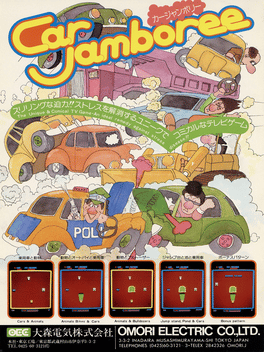
Big Fight: Big Trouble in the Atlantic Ocean, is a 1992 fighting game / belt scrolling beat 'em up-hybrid arcade game developed and published by Tatsumi, and is one of their last arcade games before focusing on novelty sticker printing business. Tatsumi added two different modes to Big Fight: a beat 'em up mode and a versus fighting game mode.Car Jamboree
1983
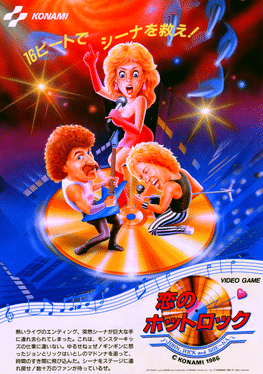
Koi No Hotrock
1986
Kokontouzai Eto Monogatari
1994
This is a strange game that deals with two cats; a pink and white one (player 1) known as Nyan and a brown and white one (player 2) known as Dodonpa. One day, Nyan questions the Chinese Zodiac and wonders why a cat isn't part of the zodiac while others like the dog and monkey are. Dodonpa isn't really bothered by it so much and sort of teases Nyan but then he too wonders about it and Nyan (feeling inspired) gets optimistic. The story of the game has Nyan and Dodonpa eventually going to meet a fairy after battling 12 animals (specifically of the Chinese Zodiac) in order to make the request that cats be part of the zodiac. Apparently, if you play with player 2 and beat the game, the ending is slightly different or so I hear. Kokontouzai Eto Monogatari (KEM from this point forward) roughly translates into "Chinese Astrology Story for All Ages". However, the game has a lot of stages for a puzzle game (13 to be exact) and the speed picks up pretty quickly so as childish as it looks, it definitely requires skill on thKonami 88
1988
Konami 88
1988
Konami '88 (also known as '88 Games or Hyper Sports Special) is the third in the Track & Field game series by Konami, where you test your Olympic skills against other world-class athletes. As the name implies, it is loosely based on (and not licensed by) the 1988 Summer Olympics in Seoul, South Korea. Bronze or silver medals are not good enough - you have to go for the gold to get to the next event. However, you must at least qualify in each event in order to compete in the next event:Koro Koro Quest
1999
Korosuke Roller
1981
Korosuke Roller
1981
Time to take up your paint brush and paint the town Red (or Green or Orange, or whatever color you happen to have on hand)! A pair of fish are out to stop you but you can roll over them at the overpass. There's other items that just try to mess up your paint job; you can run over these folks easily (if you catch them).Kosodate Quiz My Angel 2
1997
KOSODATE QUIZ : MY ANGEL 2 is the second sequel of unique quiz simulation games in where players can enjoy assuming the role of a couple of newly parents who must raise their newborn daughter from the age of 0 until the age of 25.Koutetsu Yousai Strahl
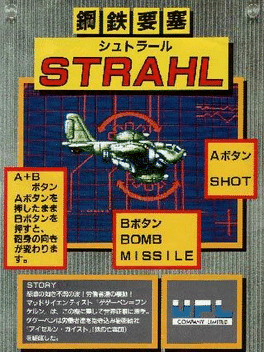
1992
The game takes place in modern times where a great depression has swept over the world. Amidst the depression and its riots of jobless workers, a mad scientist starts his plan of world domination. Taking command in the titular fortress orbiting Earth, the evil Doctor Gegeben Funkerun uses his own robots, flying fortresses and mercenaries to wreak havoc across the globe until all his demands are met. Assisting the attacked and weakened governments, workers across the nations help develop a series of jet fighters called the Aizerun Geist to use against the forces of Dr. Funkerun and save the world. Before each stage begins, players are given a choice of weapons to purchase at a hangar for the Aizerun Geist. There are four weapons within three tiers to choose from including Main Attack, Sub Weapon and Bomb. Of the Main Attack the player can choose Twin Shot, Laser, Heavy Laser and the Charge Shot. Of the Sub Weapons, players can choose additional firepower, Homing Missiles, Shielded Options or an energy barrier. PlayKung-Fu Taikun
1984
Kyuukyoku Sentai Dadandarn
1993
A trio of supervillains unleashes an army of gross mutants on earth on order to start an alien invasion. Our only hope is the trio of superheroes known as the 'Ultimate Task Force'. Squash the evil mutants and put an end to the alien menace. Features excellent graphics & sound as well as plenty of moves to find!Labyrinth Runner
1987
Labyrinth Runner
1987
You control a warrior fighting through a labyrinth against spiders and other monsters.Jyangokushi - Haoh No Saihai
1999
A Mah Jong game based on the story of the romance of the three kingdoms.Kaiketsu Yanchamaru
1986
Kaiketsu Yanchamaru
1986
One day in Feudal Japan, Kid Niki, the most radical of ninjas, is training at his Ninja School. Suddenly, a passing bird is struck down by an arrow and lands at Niki's feet. Attached is a note explaining that Niki's girlfriend, Princess Margo, has been kidnapped by the evil Stone Wizard. With the cry of "Will help you!" Niki bursts through the wall of his school and sets off on his quest to save Margo.Kaitei Daisensou
1993
Kaitei Daisensou
1993
Also known has In the Hunt outside of Japan. An organization known as the D.A.S. (The Dark Anarchy Society) uses magnetic doomsday machines to melt the polar ice caps and thus desolate the world. Although the entire world is flooded, a few societies survive to build over the highest structures they can find and continue living. In this post apocalyptic scenario, the D.A.S., who were prepared for this catastrophe, reign supreme over the survivors with martial law and military weapons of extraordinary power. Upon learning of a new D.A.S. superweapon being developed, "Yugusukyuure", the remaining survivors who are terrorized by D.A.S. secretly organize a rebellion force using a newly developed submarine known as the Granvia. The Granvia’s mission is to dive into D.A.S. enforced waters, territories and eventually the D.A.S. headquarters itself to destroy every single D.A.S. weapon in sight.Kaitei Takara Sagashi
1980
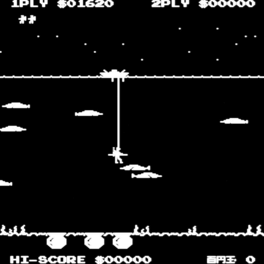
Use the 2-way joystick to direct the boat across the surface of the ocean, then press the button to lower the diver down to the bottom of the ocean while watching out for the sharks swimming across the screen. During this time, you can hold the button to pause the diver's descent and push the joystick in either direction to fire a harpoon at the sharks for 30-300 points apiece. Once the diver has reached the bottom of the ocean, push the joystick in either direction to make him walk towards either of the two treasure caches that are closest to him (the boat will automatically follow his movements at this point). When the diver is directly over a treasure cache, the boat will lower him into it. The amount of points you will receive when you make it back onto the surface of the ocean, which can range from 50-250, will then appear on the screen, and the boat will raise the diver back up to the surface of the ocean. Once again, you can hold the button to pause the diver's ascent, and push the joystick in either directiThunder Hoop
1992
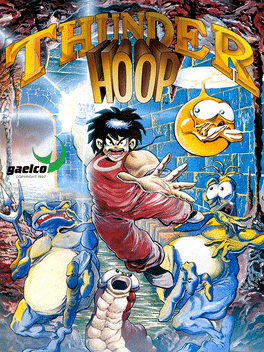
Thunder Hoop
1992
Thunder Hoop is a 2D side-scrolling platform game that puts players in the shoes of Thunder Hoop. Thunder Hoop has to stop the uncontrollable creatures professor Genbreak has released into to the world. Genbreak was forbidden to continue his dangerous research in creating these creatures, but exasperated, he created them all the same. Thunder Hoop was specifically developed in a laboratory to counter these creatures.