Most Popular Arcade Games - Page 127

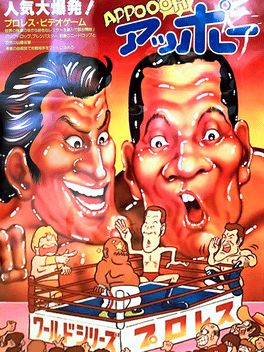
Appoooh
1984
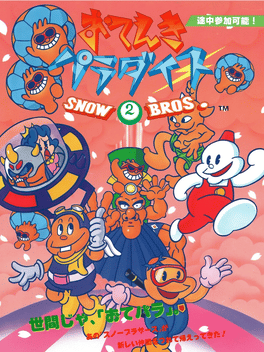
Snow Bros. 2: With New Elves
1994
Snow Bros 2: With New Elves (おてんきパラダイス Otenki Paradise) is a platformer developed by Toaplan and published by Hanafram in April 1994. It is the second and last official game in the Snow Bros series and the last game developed by Toaplan before they declared bankruptcy in 1994. The game consists of 6 worlds. The player must clear the screen of enemies to advance to the next stage. The game supports 4 players, but requires a 4 player harness for the additional players.Snow Brothers 3: Magical Adventure
2002
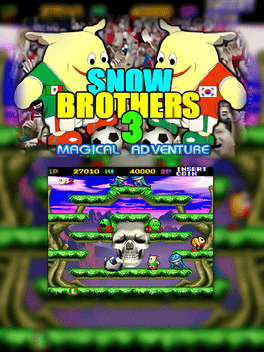
Snow Brothers 3 - Magical Adventure is a platform arcade game released in 2002 by the Mexican Syrmex. Although the manufacturer has announced the continuation of the series as an original Snow Bros in reality it is a clone. The 50 levels that make the game are almost the same as the first Snow Bros except for sprites and backgrounds, here replaced by forografiche images. The only other difference is that to take the place of snowballs there are footballs. At the end of the game a screen with seven half-naked girls and the words Thank Snow Brothers.Police Trainer
1996
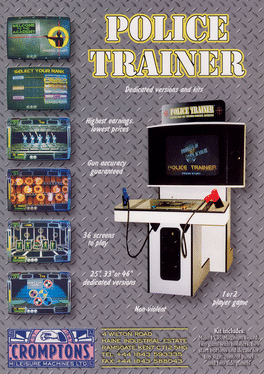
Police Trainer
1996
Police Trainer is a light gun arcade game released by P&P Marketing in 1996. A sequel, Police Trainer 2, was released in 2003. Players have only three lives to complete six exams in each difficulty. Players can lose lives by either failing to reach a quota, not defusing any C4 or letting the guards hit the player. In order to complete the competition mode, players must lose one life on player 1 and lose one life on the other. If the players fail each mode, they can either try the same mode again or select a different mode. If the players completed each mode, they can select another mode until a difficulty is completed. Each difficulty consists of six stages. Players can put initials after completing the Commissioner difficulty. Shooting the incorrect targets receives a –100 points penalty.GunNail
1992
GunNail
1992
Gunnail is a vertical space shoot'em up. It's a very standard shooter - very fast action, and many enemies to kill. Player controls a space ship, and flies straight forward. He must destroy enemies - the spacecraft has a gun that can be improved by power-ups and special weapons. Player can obtain helpers ("option" from Gradius). At the end of each level a boss awaits - every boss is heavily armed and difficult to destroy.Area 51: Site 4
1998
Area 51: Site 4
1998
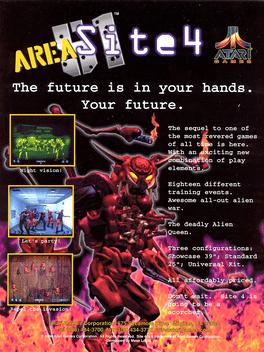
Area 51: Site 4 is a light gun arcade game developed by Atari Games in 1998. It is a sequel to the original Area 51, picking up where that game left off. Though the graphics have been improved, they rely on the same FMV streaming technology as the original, and the gameplay remains largely the same as the original game.Cyvern
1998
Cyvern
1998
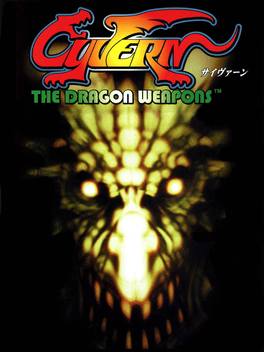
Cyvern: The Dragon Weapons is a vertically scrolling shoot 'em up released in 1998 by Japanese company Kaneko. Cyvern's storyline involves biologically engineered dragons created as the ultimate military weapons. To add extra power, the dragons were enhanced with robotic wings and cannons on their backs. This is mostly an excuse to blow things up using cyborg dragons.Change Air Blade
1999
Change Air Blade
1999
This game is the first 1 on 1 shooter where the second player who plays on the upper half of the screen can morph into a "boss".Charlie Ninja
1994
Charlie Ninja
1994
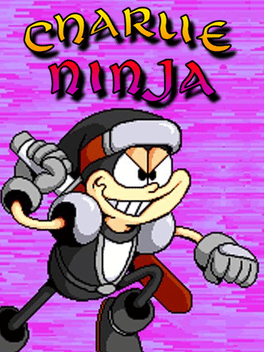
You control a cartoonish ninja-type character who must attempt to shoot all the enemies and defeat the boss at the end of each stage.Cool Boarders Arcade Jam
1998
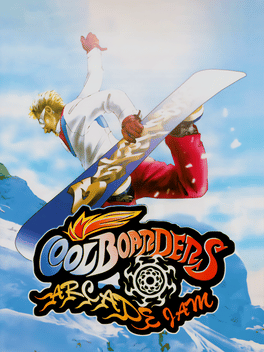
Cool Boarders Arcade Jam is an arcade snowboarding game in the Cool Boarders franchise.Cyber Cycles
1995
Cyber Cycles
1995
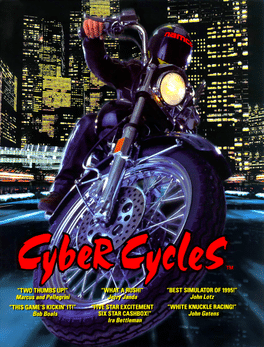
A motorbike racing game featuring 2 courses; Greenhill: A high-speed track along the coastline and Neo Yokohoma: A futuristic technical course in an urban area at night.Dirt Dash
1995
Dunk Mania
1995
Gaiapolis
1993
Black Heart
1991
Black Heart
1991
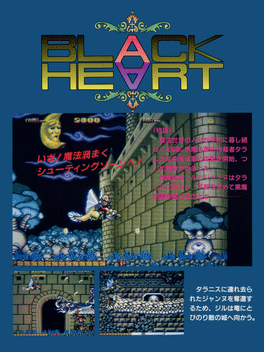
Black Heart is a horizontally scrolling shoot 'em up arcade game released by UPL in 1991. The player controls a fire-breathing dragon and shoots enemies with fireballs, collects power-ups, and defeats bosses to advance levels.Viper Phase 1
1995
Viper Phase 1
1995
By the year 2050, mankind begins the colonization of multiple solar systems in search for habitable planets. However, while the colonists establish original cultures and scientific studies, many of them began feuding with each other and battles broke out among them and the Earth. One rebel faction in particular rose to great power and made Earth their primary target. Earth's response was Operation Viper Phase 1: to combat the rebels using advanced space fighters built from downed enemy ships.Big Striker
1992
Blomby Car
1994
Blomby Car
1994
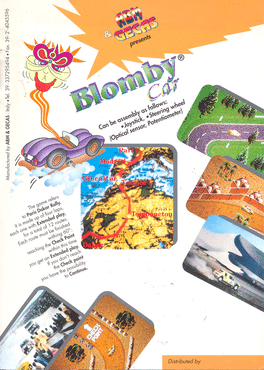
A rally driving game from ABM and Gecas. It has nicely detailed graphics and some speech announcing each course.Zero point 2
1999
Zero point 2
1999
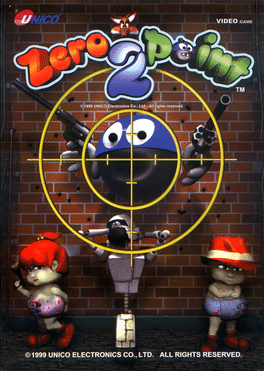
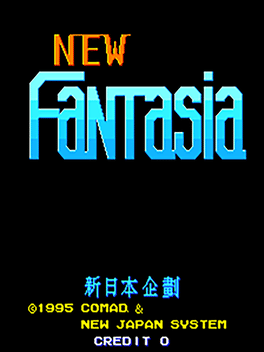
A shooting game controlled by a light-gun. Its the 2nd game in the Zero point series.New fantasia
1994
New fantasia
1994
New Fantasia was produced by Comad/New Japan System in 1994. It's a Gals Panictype game with 32 models that you are able to choose to begin at any stage.